Tag Archives: Brexit

The Night Before

The remnants of party poppers lie scattered, half-empty glasses wait to be cleared, and the hazy memories of last night’s revelry already begin to blur. We gulp down a cocktail of hangover remedies, hoping to patch together some clarity. A collective breath is drawn—a mix of relief and exhaustion—as if the madness of the past four years might finally loosen its grip. Yet this morning feels unchanged, mirroring the day before. The same yawning chasm that haunted us then remains unbridged, and still, we dance around the fire that has consumed us.

We are mourning. Lost and confused, grasping for a sense of normality that slips through our fingers—unspoken, almost unspeakable—because those forces that shaped our world have clipped our words, our voices, our right to express freely.

‘They’—a shape-shifting specter, different for each of us—have molded us into self-imposed victims. Blame is cast outward, always someone else’s fault. But as the dust settles, and we stand solitary, the weight of accountability falls squarely on our shoulders. The pothole in the road, the endless waiting lists, the insecurity of zero-hour contracts, even the crooked bananas on the shelf—we face these realities now, with no one else to blame.

Today, we stand, chest puffed against the cold wind, alone. But the turmoil of these past years was a symptom, not the root. And last night’s fleeting celebration—no matter how loud—was never the cure.

Behind the Scenes of Global Metal Trading: The London Metal Exchange and Its High-Stakes Future

It might seem dry — even dull — but beneath the surface, the London Metal Exchange (LME) is a cornerstone of the global economy. Situated at 10 Finsbury Square, London, the LME is the undisputed hub for trading industrial metals ranging from lead to gold. In 2018 alone, it handled a staggering $15.7 trillion worth of trades, moving 4.1 billion tonnes of metal ‘lots’ worldwide.

The LME’s story took a pivotal turn in 2012 when Hong Kong Exchanges and Clearing Limited (HKEx) acquired the 135-year-old institution for approximately £1.4 billion. HKEx, itself formed in 2000 through the merger of three Hong Kong financial entities, has positioned itself as a global market giant with a strategic focus on “China Connectivity.”

The acquisition raised eyebrows at the time. The Financial Times reported that the deal was a lucrative windfall for major banks and brokers, with JPMorgan, Goldman Sachs, and the Bagri family (owners of Metdist) receiving hundreds of millions in payouts. Meanwhile, the LME’s Chief Executive was reportedly set to receive a bonus nearing £10 million.

Seven years later, the ambition to build a seamless commodities bridge between East and West has fallen short. As HKEx Chief Executive Charles Li candidly put it: “All you need to think about is if this is the right asset for us. The rest is detail. You don’t worry if the price is right.”

The geopolitical and financial context continues to evolve rapidly. In December 2019, Valdis Dombrovskis, the European Commissioner for Financial Stability, issued a stark warning to the UK. Post-Brexit, London’s financial sector risks losing its privileged access to EU markets unless it maintains close regulatory alignment. Speaking to the Financial Times, Dombrovskis underscored that “access will depend on Britain not starting to engage in some kind of deregulation.”

As tensions simmer in Hong Kong — where Beijing accuses foreign powers of fomenting unrest — China watches closely the unfolding UK-EU negotiations. The LME itself is not idle, maintaining a strategic presence on the 7th floor of the MYP Centre in Singapore, clearly positioning itself amid shifting global trade currents.

In a world where markets, politics, and diplomacy intersect, the future of the London Metal Exchange will be a barometer not only of metal prices but of broader geopolitical alignments — a silent, yet potent, indicator of the times.

A Raw Slice of British Grassroots Politics

Tucked away on Sandy Park Road in Brislington, Bristol, The Sandringham Pub stands firm—a no-nonsense local, tired but proud amid the growing café culture around it. Downstairs, regulars exchange stories and catch up on the day’s events, while upstairs, political hopefuls ready themselves for a hustings meeting—an intimate, sometimes chaotic forum where candidates lay out their cases for election or re-election.

Arriving early into a near-empty room, the scene is instantly vivid: an abandoned Father Christmas costume slumps in a corner, a well-worn skittle alley runs along one side, and a Banksy print hangs silently behind. The occasional flushing of toilets, inconveniently placed near the skittle lane, forces the audience to awkwardly navigate behind the speakers—adding a quirky charm to the proceedings.

The organisers’ attempts to arrange the top table provide their own drama. Tables shuffle, six glasses of water repeatedly move back and forth, as they try different seating angles—only to concede that either the chair or a speaker will inevitably end up on the skittle alley itself.

The evening unfolds like a scene from an Armando Iannucci script, mixing pantomime and personalities with genuine grassroots politics. There are serious debates, passionate hecklers, entrenched political tribes, and the occasional bemused visitor who’s clearly taken a wrong turn on the way to bingo.

In an age dominated by spin, social media echo chambers, and soundbites, there’s something refreshingly raw and honest about these meetings. They bring people with clashing views face-to-face, encouraging listening, dialogue, and the stark realisation that shared concerns bind us more than anger divides us. Here, it’s clear: the journey matters as much as the destination.

Brexit, inevitably, looms large. Like a faltering stroke victim struggling to articulate, no other topic escapes its shadow. It’s simultaneously depressing and fascinating to watch, as each speaker’s eyes reveal a shared weariness. We’re all stuck in the same ditch, grasping for symbolic deadlines to “get Brexit done,” yet no one truly knows how to heal the fractures within families, neighborhoods, and communities.

Some politicians push for a knockout victory, but victory over whom? In life, total victory is neither practical nor desirable. The art of compromise may seem absent now—but it’s only a matter of time before she comes knocking. Let’s hope we have the wisdom to answer the door.

Summer Holidaze

Stanley stood rigid at the curb, Doris by his side, her hand brushing his. Down the hill, the driverless bus thundered toward them, metal beast on wheels, scraping inches past where they waited. Inside, a tempest roiled.

Passengers brawled, voices cracking like broken glass. Village faces peered anxiously, jaws tight, eyes wide.

Theresa sat just behind the empty driver’s seat, fingers stuffed in her ears, lost to the storm. Opposite her, Jeremy covered his eyes, peeking through his fingers at the vacant wheel, whispering a prayer—hope and defiance tangled on his breath.

Behind them, Nigel’s long finger jabbed accusingly at the last few who’d boarded. “Sabotage!” he barked, voice sharp enough to cut glass.

A small mob spat curses—at one another and at the chaos itself. The bus jolted over bumps, and Ariaf’s grip slipped. A vanilla shake splattered over Tommy’s new school uniform. He wailed, clutching Bernard, his pet snail, now hidden away in a cardboard box. “How’m I gonna tell Mum?” he sobbed, finger already pointing.

Vince bounced up and down, desperate for notice after being banished for helping David—the driver—to escape through the emergency hatch.

Nearby, self-styled ideologues debated, trading grudging praise for the 1939 Molotov–Ribbentrop Pact, their eyes glittering with twisted admiration.

Caroline sat alone, calm and patient, knitting a jumper stitch by stitch, waiting.

As the looming brick wall hurtled closer, Chuka, Anna, and Heidi linked hands with others, raising their voices in ancient hymns.

Nicola shouted for a show of hands—any brave souls willing to climb to the roof. Ariene screamed, “No surrender!” as the wall grew impossibly close.

Meanwhile, the nation sat glued to radios, Cliff Richard’s Summer Holiday on eternal repeat, young faces exchanging helpless, desperate looks.

Stanley caught Doris’s eye, his voice soft but certain. “Ah Doris, Brexit means Brexit.”

She licked her melting ice cream, then turned to the pelican crossing button. The sharp beeping sliced the chaos, halting cars. Hand in hand, they stepped off the curb, away from the madness, crossing to the bus station as if nothing had changed.

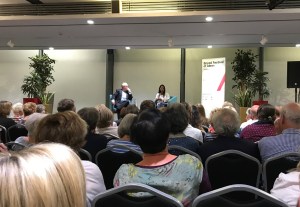
Gina Miller: Bristol Festival Ideas: 04.10.18

A Portrait of Division and Defiance Tuesday evening found me in the company of Gina Miller, a figure best known for her landmark legal challenge that forced the UK Government to seek Parliamentary approval before triggering Article 50 and beginning the Brexit process. In today’s fractured political landscape, Miller has, willingly or not, become a beacon for those desperate for leadership and clarity amid the chaos.

But the price of such visibility has been horrific. Miller has endured an unrelenting torrent of abuse—threats of violence, racial harassment, and vile misogyny. Her personal office has received dangerous packages, her legal team harassed outside their workplaces. Even members of the aristocracy have targeted her with vile, hate-filled public remarks, including the 4th Viscount St Davids, who called her a “boat jumper” and offered a bounty for someone to “accidentally” run her over. The vitriol is a stark and disturbing reminder of the dark undercurrents roiling beneath our society.

How did we get here? It’s a question that haunts me, no matter what side of the political divide you stand on. What has stirred such profound hostility, such a corrosive bitterness? This isn’t mere political disagreement—it is a deep, painful darkness that strikes at the heart of community and civility. It is the ugly resentment of the “grumpy uncle” or the neighbour who blames everyone but refuses to reflect.

Just last Sunday, I spent over two hours at a public meeting discussing a proposed winter shelter for the homeless in my neighbourhood. Such topics are always delicate, often inflaming frustrations about local governance and the fear of change. Yet none of that could excuse the venom directed not only at the council but, heartbreakingly, at those most vulnerable in our community—the homeless men and women who face the real threat of freezing to death this winter.

Concerns over property values and personal safety are understandable, and the council must address them calmly and clearly. But the atmosphere of the meeting was poisoned by hostility—a relentless, almost physical rage. Hands clenched, faces reddened, and interruptions were constant. This was not debate, but a display of emboldened intolerance and disregard for others. It mirrored the wider social fracturing Gina Miller speaks of—our inability to listen, empathize, and engage with each other as fellow citizens.

Miller’s analysis tonight resonated deeply. She spoke candidly about Brexit, the erosion of political accountability, and the urgent need to open dialogues across our fractured nation. Yet, some of her hopes—like the promise of a kinder, more socially aware capitalism—felt, at times, overly optimistic. Waiting for the financial elite to embrace genuine reform is a hope long deferred, especially for those who have borne the brunt of failed market-based solutions since the 1980s.

The mood in the room was one of grief and bewilderment, particularly during the Q&A when Miller called for outreach to those who voted for Brexit. An elderly man’s question, “How do we get into their heads to change their minds?” spoke volumes—not just about political division, but about a profound misunderstanding. It’s not about “getting into heads,” but about listening, showing empathy, and supporting policies that address real economic injustice.

Gina Miller is an extraordinary woman—a symbol of courage and common decency in an age where both are in short supply. The hatred she endures is despicable and must be condemned unequivocally. While her recent switch from Labour to the Liberal Democrats may disappoint some, it reflects her commitment to an ethos of “kinder capitalism,” even as we acknowledge the irony of austerity policies that sowed seeds of Brexit under the previous coalition government.

Perhaps, in the aftermath of Brexit’s tumult, we will better appreciate the value of Miller’s work. For now, as I finish this reflection, a new report from the Institute for Public Policy Research lands in my inbox. It calls for a “radical overhaul” of Britain’s economy comparable to post-war reforms or Thatcher’s revolution, to confront decades of stagnation since the 2008 crash.

Insightful, well-meaning—but for many, it feels like a call made while Rome burns.

Blue not burgundy is the new black

There is a crucial moment in the first Matrix film when the character Neon is presented with a life-changing choice by Morpheus between taking a red or blue pill“You take the blue pill, You wake up in your bed and believe whatever you want to believe. You take the red pill, you stay in Wonderland.” For those not familiar with the Matrix films the term red pill refers to a human who is aware of the true nature of the Matrix. There is a myth, which persists in the minds of some people in U.K. that the European Union forced the U.K. to change the colour of its passports from blue to burgundy and by regaining the original blue passport is a mark of national identity, sovereignty and taking back control. In the comedy of errors that has become the U.K these things matter to somebody, somewhere, for some reason for which I am not entirely sure. These are the people who have swallowed the blue pill.  Those who have taken the red pill know the British government voluntarily switched the colour of our passports in the 1980s and the EU has never had the power to force member states to change the colour of their passport.

The “news story’ about the colour of our passport is what many would call a politically manufactured distraction or spin after another terrible week for the sitting zombie government in the U.K, which slips and slides from one crisis to another. Meanwhile, properly one of the most progressive-left opposition sit waiting in the wings to deliver a killer blow. To early and Labour will be left picking up the mid-negotiation mess, much better to wait until the next round of negotiations is well underway. This will give an incoming Labour Government, which will not used to the rigours of a free-market economy as enshrined in EU treaties and law to intervene more radically in the economy. It’s not the type of ‘taking back control’ the Brexiters had in mind, but how ironic it would be. PS: The original colour of the British passport was black. Carry on swallowing the pills. 

SaveSave

SaveSave