Tag Archives: love

Life’s Little Embers

I once heard a quote, “a person does not truly die until the last person who knew them, to speak their name, also dies.”  I find much beauty and poignancy in such an observation. It is one that gives context and comfort during those periods when context and comfort are not in abundance. It is within this context that I write a small piece on 3rd May, each year, for my parents. During the final years of their lives, I took regular photographs of my parents so I could share them with their grandchildren, great-grandchild and wider family. Stored securely on a memory stick on this day I take that memory stick out, select a photograph and write a little something. Initially on closed social media platforms like FaceBook and more lately on open media like this from last year. This photograph was taken a couple of weeks before Mum’s health deteriorated rapidly over a very short period of time.
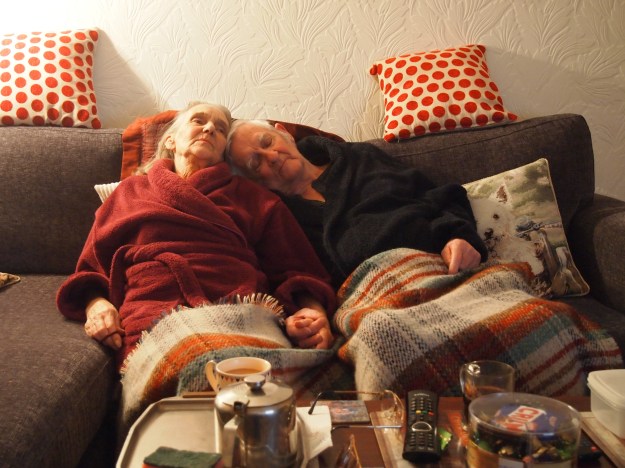
They had a routine, which generally consisted of them living separate lives during the day with occasional chats as one of them would make a pot of tea or meal. Dad, in the front room with his latest model building project. Mum, in the back room, reading and watching the latest soap. Pet dog seeking attention from either one of them. Each evening they would share their meal, cuddle up, natter and watch TV.

In my final year with them, I got the opportunity to hug them, share stories, tell them how much I loved them, explain to them how proud I am to be their son. As a family, to express in their later years that it was an honour to care for them. This became the foundation for coming to terms with not having them physically in our lives. It’s the small stories that become important. My dad asking for, “gingersnap biscuits to be put in his pocket when we put him in his box.” My mum reminding us, “make sure your dad gets his meals” during last days she was able to communicate. The search for my mum false teeth after she passed away and then to find her gnashers many months afterwards in the back of my car without any rational reason why they should have been there. I’m also happy to report that nothing gives me more satisfaction than hearing their grandchildren and great-grandchildren share these small anecdotes.

The Road Between Woolwich to Eltham

Woolwich, a small corner of London often overlooked, tells a tragic story of a community caught between change, division, and neglect.

Like shifting fault lines beneath the surface, Woolwich is vulnerable to social fractures. It shares London’s diversity—a mix of cultures, faiths, and races—but unlike much of the capital, it remains deeply polarised. Here, acceptance often feels reluctant and tolerance begrudged. Despite nearby developments, Woolwich never benefited from the economic boom of the 1980s, and it continues to bear the harsh consequences of austerity measures.

Until the 1960s, Woolwich’s white working-class communities provided much of the labour for the military industries that dominated the area. Today, many have moved away to neighboring areas like Charlton, Eltham, and Plumstead, while new populations have settled in peripheral estates such as Thamesmead—an area defined by stark Brutalist architecture, famously used as the backdrop for Stanley Kubrick’s A Clockwork Orange.

Woolwich’s industrial heritage runs deep. It is the birthplace of Woolwich Arsenal Football Club—known today simply as Arsenal—a club whose nickname, ‘The Gunners,’ remains a reminder of its origins. Football was once the heartbeat of working-class life here, a cheap and accessible escape, tightly woven into community life alongside trade unions, local pubs, and family-run businesses.

However, the collapse of Britain’s industrial base in the 1970s, combined with globalisation and increased migration, radically transformed Woolwich. The area became home to large numbers of immigrants seeking affordable housing and new opportunities. This demographic shift brought cultural richness but also rising tensions—between first, second, and even third-generation immigrants, and between new arrivals and established residents.

Local institutions, including mosques, evolved to serve increasingly diverse congregations. Yet while middle-class Britain has largely embraced multiculturalism through cultural festivals and events, many in Woolwich’s white working-class communities have felt left behind—economically, politically, and socially.

As opportunities vanished and political representation faded, extremist groups found fertile ground. The National Front’s notorious bookshop in nearby Welling was led by Richard Edmonds, a veteran of far-right politics. Racial tensions between youth gangs escalated, culminating in the murder of Stephen Lawrence in 1993—a killing that shocked the nation and exposed deep flaws in policing and race relations.

Twenty years later, Woolwich was once again the scene of a shocking and violent event. On May 22, 2013, Lee Rigby, a 25-year-old soldier and father, was brutally murdered on the streets. Two men attacked him with knives and cleavers in broad daylight. The attack was captured on mobile phones and broadcast widely, leaving the country in stunned disbelief.

I know Woolwich. I lived and worked nearby. I know the streets where Lee Rigby was murdered, where families and colleagues walked safely just days before. Whatever one’s views, nothing justifies this act of violence and horror.

Soldiers often follow orders without control over political decisions. The families in conflict zones who lose loved ones share the same hopes for peace and stability that Woolwich’s residents seek for their children.

In the aftermath, far-right leader Nick Griffin visited Woolwich, a move widely seen as opportunistic and inflammatory.

Now is a time for dignity, reflection, and unity—not division. The wounds in Woolwich remain open—racial and social fault lines that, if left unaddressed, threaten further violence and mistrust. These tensions play out daily in real life—in schools, markets, and neighbourhoods—waiting for the next spark. The murders of Stephen Lawrence and Lee Rigby are grim reminders of this reality.

My deepest respect goes to their families and to the brave Woolwich residents who tried to help on that terrible day. One image stands out: two Black women tending to Lee Rigby’s lifeless body, holding his hand, offering comfort amid horror.

Twenty years on, Woolwich remains a place of challenge—new developments are springing up, big money is changing its face and community once again. Where do the people who can’t afford to buy into this new world go?