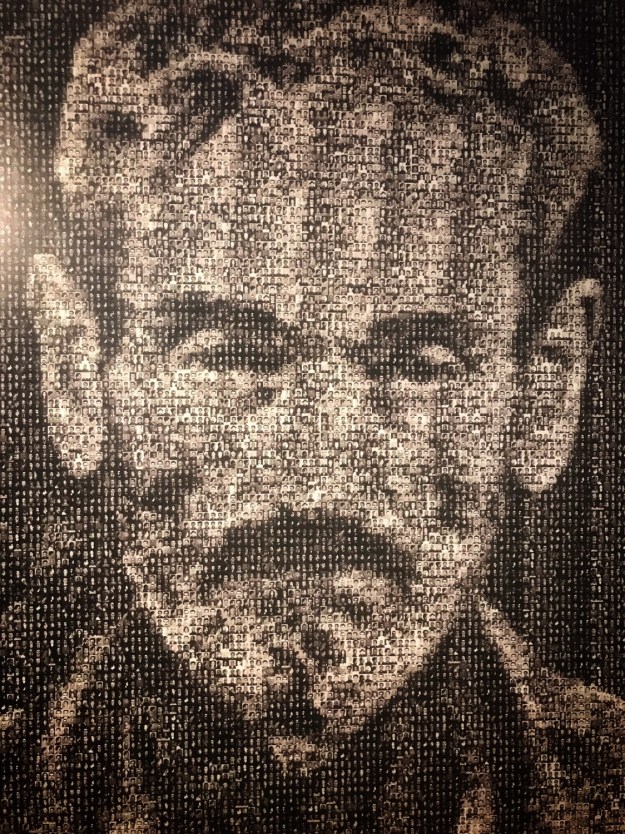
A photography I took while visiting the Museum of Aljude: Resistance and Freedom in Lisbon last week. Graphic composition by Paulo Andringa Caldeira of Amavel Vitorino a shoemaker from Mora, Portugal, made with the faces of political prisoners. Vitorino was arrested in December 1940 for making “unpleasant comments on the current political situation of the country and its leaders.”
I don’t recall his name, but it was New Years Eve 1998, the comedian walked on stage and was warmly welcomed. His opening gag, “Scotland is celebrating tonight….Lena Zavaroni has had a shit.” His comic timing was impeccable. The room filled with equal bouts of laughter, gasps and groans. It’s a gag that has stuck with me. Not because of any comic value, but its cruelty, given it was common knowledge that Zavaroni, a child star of the 1970s, had been suffering from anorexia since her teenage years and within a year of this gag the 35-year old Zavaroni was dead. The only thing I took heart from that night was the thinning audience seeking refuge in an adjourning bar where it was concluded the comic was boring, a one-shot pony, no depth and no charisma to manage an audience beyond aiming to shock. Years later 3 things often cross my mind from that evening.
The feelings of those in the process of losing a loved one, if they were to discover their loss, suffering, pain and devastation was joke material.
The ability to offend and be offended is an integral part of a functioning democracy and should be defended. An argument often overlooked by those on the left and misused by those of the right.
Thirdly, by walking out of the comic’s routine, which he will have noticed, we the audience, were in effect holding him to account.
20 years later and the willingness to say something shocking, offend, slag off or degrade is epidemic, even those seeking, accepting or obtaining public office are in on the act, but like that comic, they are often dull and as sure as night follows day accountability ultimately catches them up. Alexander Boris de Pfeffel Johnson MP the illustrious Secretary of State for Foreign affairs in the UK (one of the prominent 3 positions in UK Cabinet government). Johnson has sought to position himself as a Trump type character for the common man. Endlessly projecting himself as an affable, jovial person, he is now widely viewed as an incoherent train crash on Thomas the Tank proportions.
Johnson is of that ilk, a background of wealth and privilege giving a pretentious and mistaken belief they are not constrained by the standards decent people self-regulate to demonstrate their dignity. A sense of respect towards others including those less fortunate. Johnson sense of privilege allows him to casually describe war-torn Sirte, Libya as potentially the next Dubai once the dead bodies were cleared away. In this context, it became of little surprise that Johnston ran to the defence of his fellow traveller Toby Young, (journalist and self-styled educationalist) who has recently been appointed to a government-funded educational quango (The Office of Students). Young believes people attacking his appointment is because of his ‘outspoken Tory’ views, but while this may provide logic to some people, as a parent, with a daughter entering the university sector shortly, his politics are not of my concern on this occasion.
There are principled conservatives, as there is across the political spectrum, who have a sense of service, standards and ethics. They understand the tone they adopt provides a sense of responsibility, leadership and integrity, which underpins our trust and confidence in those wishing to serve the greater public good. Toby Young is not one of them. Toby Young is my 1990s forgotten comic making observations about “huge knockers, having a dick up a woman’s arse, gloating over baps, wanking over the efforts of Comic Relief to raise money for those in need and referencing working people as stains and deformed.” The critical difference between my 1990s forgotten comic and Toby Young is simple. My forgotten comic has never, to my knowledge, sought or accepted public office.
Young’s appointment is rightly receiving the criticism it deserves, and given the noise, he has released a statement regretting “the sophomoric, politically incorrect remarks on twitter and I hope people will judge me on my actions.” Schizophrenically Young is seeking to present himself twice. The virtual Toby detached with less accountability and the Toby in the real world. The real world Toby is demanding to be taken serious convinced in his self-belief, righteous education and privilege that he was born to offer us all the benefits of his gracious service. There will be those who find Young’s observations as the pinnacle of modern ironic comedy as part of the fight back against a politically correct world constructed by the liberal elites, which he and his ilk have built in their heads. A world, which they believe suffocates their freedom to call a spade a spade. It is a world where the ‘alt-right’ see themselves as freedom fighters against disabled ramps. A world where the context of equality is determined by wealth, status, the social network you belong too and what remains is a matter of charity.
2014, in an open letter to sitting Prime Minister David Cameron, Lord Paul Bew, who chaired The Ethical Standards in Public Service wrote about the public desire of wanting those involved in public life to adhere by common ethical standards. Lord Bew hit the nail on the head when he wrote, “for the public how things are done are as important as what is done.” The ethical standards Lord Bew was talking about are Integrity, objectivity, accountability, openness, honesty and that holder of public office should exhibit these principles in their own behaviour.
By appointing Toby Young, Theresa May is setting the bar for her standards, so what next how about Roy ‘Chubby’ Brown to head up a public body into women’s health. Katie Hopkins to front up a refugee relief quango, how about an Honourary Lordship for Trump in recognition of his work in building religious tolerance? To use your own words Mr Young “I hope people will judge me on my actions.” Well for my small part here I am judging you by your actions and the standards in public life.
The subject matter is and always will remain challenging. Homelessness: The Reality on the Ground is the type of issue that can generate fear and ignorance in equal proportions. Those who may have believed they were at little risk of the housing crisis are increasingly being sucked into the vortex of a perfect storm. Inaccessible market values, extreme rent levels, a lack of supply, the return of poor landlords and the paralysed inability of government has placed the fundamental human need of shelter into the hands of the speculators and spivs. As we discovered during the panel presentations and discussion (Downs Festival 2017) homelessness once considered the blight of those on the fringes of our society is now showing its ugly face amongst paid workers, especially the working young. There is a broken promise in any social contract between individual and state when homelessness rears its ugly head. The crisis we now face sits at the feet of those who have governed for the past 40 years and willingly encouraged the breakdown of decency towards humanity. Homelessness on the scale we witness has not happened by accident. It is a deliberate policy designed and orchestrated by the government.
So what is to be done as we sit in self-imposed ignorant bliss, knowing the causes, but claiming to be ‘powerless’ to do anything? Being powerless can, of course, be a convenient excuse and one that in its worst condition seeks self-reflected pity on oneself. The cold reality is that some people vote to be powerless. The first step in demanding change is the realisation that you are not powerless and by actually doing something, no matter how little, you become a small, but integral part of a social movement and movements change things on a big scale. The words ‘political struggle’ in one of the wealthiest economies, had until recently, become an almost embarrassing term to use given the abundance of riches at our disposal. It is clearly back on the agenda for a younger generation who are quite rightly increasingly restless and angry at the inheritance being offered to them by a tired and self-imposed ‘powerless’ older generation. While government (nationally and locally) is blindfolded in a downward spiral of spin, apportion blaming and rebranding their diminishing resources as new. Informal networks of self-motivated people armed with nothing more than compassion and love are seeking solutions. On one hand, a growing number of people are not prepared to ‘walk on by’ and ignore the injustice staring them in the face and on the other hand young people are increasingly motivated to get involved in direct-action and structured politics. It’s too early to say if this is a fad and it may suffer the relentlessly grind wheels that have often warm many a good person down, but positive seeds have been sown.
It was an absolute honour to have co-hosted the panel on Homelessness at the Information Stage, Bristol Downs Festival with friend and film director Anthony Tombling. The panel brought together people and groups who did not fall for the self-indulgent notion of ‘powerlessness’ and did the right thing. They got engaged and became part of the solution rather than the problem. Ordinary people from a variety of backgrounds, faiths, genders and cultures. My deepest respect goes out to Bristol Reconnect, Brixton Soup Kitchen, Homeless Heroes (Birmingham) Feed the Homeless, St. Mungo’s, Help Bristol’s Homeless who are doing some amazing work often off the radar. If you would like to find out more about these groups and get engaged with what they are doing then just click here.
There will always be armchair cynics in life who can’t, don’t want to be won over, or are only comfortable with the status quo. My advice is equally simple. Following the words from one generation to another…. “come, councillors, MPs and Government please heed the call don’t stand in the doorway, don’t block up the hall……come mothers and fathers throughout the land and don’t criticise what you can’t understand your sons and your daughters are beyond your command. Your old road is rapidly agin’. Please get out of the new one if you can’t lend your hand.”
29th April 2017 I was asked to facilitate a community session for the Mayor of Bristol (Marvin Rees) and Kerry McCarthy MP. The localised issues raised at community engagement sessions can often be listed beforehand housing, transport, education, fly-tipping, but nesting amongst these issues was the ongoing ramifications of Brexit. The audience while not large certainly reflected the diverse nature of opinion concerning the Brexit debate. What became clear during the session was that when politicians listen and engage with the fears and concerns of ordinary people a more considered debate takes place, which in turn helps forge a more objective understanding of the complex issues that are often presented in simplistic headlines. My lesson from facilitating this session is that we need to develop ways of breaking down the often perceived barriers between elected representatives and the general public.
It will not be easy, but social media has its limitations. There is no real substitute for eye to eye contact and exchange of opinions, which often energises and secures the principle of accountability. We have allowed the vilification of our elected representatives to cloud our wider engagement in our democracy. That is not to say some of our MPs and elected representatives have not been the cause of their own vilification. But there is a space, a void and dare I say a responsibility we need to claim back to make our democracy and accountability work.
If we are to recapture hearts and minds then it will need to be done community by community, neighbourhood by neighbourhood reconstructing the relationship and replacing it with politics that works for people.
I took some time out to read the Gender Wage Gap briefing by the Institute for Fiscal Studies, which was reported in the press today. One of the most striking observations in the report, which I came across but failed to get any reporting or comment by those lazy politicians who jump on headlines was the following remark,
“Looking at women who leave paid work, hourly wages for those who subsequently return are, on average, about 2% lower for each year that they have taken out of employment in the interim. This relationship is stronger, at 4% per year, for women with at least A-level qualifications. We do not see such a relationship for the lowest-educated women, which is likely because they have less wage progression to miss out on or fewer skills to depreciate.”
The concept of anybody being paid less simply because of their gender is just fundamentally wrong, but there is also an elephant in the room called class but let’s be honest it’s not fashionable to mention that.
In September 2012 Jose Matada, a young man of Mozambique heritage boarded a Boeing 747 at Luanda airport, the Angolan capital on route to Heathrow, London. His aspiration was simple, a hope of a better life. It is a hope that has driven migration across continents since the dawn of the human race, but what made Jose’s story quite distinctive from his fellow passengers is that Jose did not get the opportunity to saver any of the inflight food or entertainment. Jose’s body was discovered in the streets of an affluent west London suburb below the flight path of the Boeing 747 he was travelling on. He had fallen from the planes undercarriage when the wheels opened for its descent. Whilst only wearing light clothes Jose seemed to have survived the bulk of the 12-hour trip, although low oxygen levels and temperatures of -60C in the unpressurised wheel recess would have left him unconscious. He died on his 26th birthday, with a single pound coin in his pocket.
Whilst Jose’s case is rare, it is not unique with several deaths being reported on inward flights over the years. Apart from avoiding armed security guards getting into the wheelbay of a Boeing 747 is not easy. It involves climbing one of the aircraft’s 12 enormous wheels, then finding somewhere to crouch as the deafening engines taxi the plane to the end of the runway. Clinging to huge pieces of steel the plane accelerates to 180mph. It is unlikely that until the wheels start to retract that those hidden in the wheelbay understand just how much trouble they are in. Within minutes of take off passengers, only a few feet away are starting to enjoy their inflight movie, whilst the temperature in the wheelbay will have already fallen below frozen and hallucinations kick in from a lack of oxygen.
As the dust settles after the general election in the UK one thorny issue is destined to pierce the psyche of the UK as we slowly move towards a debate and referendum on our future membership of the European Union. This issue is immigration. Even if not said explicitly immigration will dominate the debate and subsequent vote. During the run up to the UK general election we were presented with an opportunity to pause and reflect on the constant dehumanisation of people we label immigrants. A journalist in one of the UK’s largest selling tabloids had published an article which contained the following, “No, I don’t care. Show me pictures of coffins, show me bodies floating in water, play violins and show me skinny people looking sad. I still don’t care…..make no mistake, these migrants are like cockroaches.” 48 hours of this article appearing the Italian PM Matteo Renzi was leading calls for more European Union action on migration. His call followed the sinking of a 70ft long boat carrying up to 700 people. Only 28 people survived. The resulting pictures were heartbreaking, which may have melted slightly for one moment the iceberg heart of the journalist who wrote of migrants as cockroaches and wanting to be shown bodies floating in water. You would think this man made tragedy and its circumstances would have helped frame a more humane attitude – I am yet to be convinced.
Headlines of shame
The ensuing debate and referendum on our future membership of the European Union has opportunity to bring forth what is truly great and decent about this country. It could help lance a few boils and open honest dialogue about who we are as a people now and into the future, which is often overshadowed by the unspoken glass ceiling of class rather than the colour of ones skin. It could give confidence to positively challenge the plastic Alf Garnett’s and “pound shop Enoch Powell’s” who nipple feed on our fears and project back a grotesque bastard off spring, who then deludingly believe they have a birth right to be the mouthpiece of so called but undefined British values. The ensuing debate and referendum could help forge the UK as a more compassionate partner both with our European partners and the rest of the world especially for those people labelled immigrants, who more than often tend to be impoverished and black. Equally, it risks setting a course that could result in retraction from the world at large in the hope that we can somehow just solider on in perfect isolation whilst the gramophone crackles out the national anthem, the Union Jack is hoisted and the good old folks can bask in yesterday’s promises. Regardless, which side you sit on, this debate is needed because the UK needs to find a settlement not just within Europe, or the world but also within itself.
Meanwhile on 18th June 2015, police were called to an incident where a body of a man has been discovered on the roof of a west London office building. The man in question seems to have fallen from a Boeing 747.
Woolwich, a small corner of London often overlooked, tells a tragic story of a community caught between change, division, and neglect.
Like shifting fault lines beneath the surface, Woolwich is vulnerable to social fractures. It shares London’s diversity—a mix of cultures, faiths, and races—but unlike much of the capital, it remains deeply polarised. Here, acceptance often feels reluctant and tolerance begrudged. Despite nearby developments, Woolwich never benefited from the economic boom of the 1980s, and it continues to bear the harsh consequences of austerity measures.
Until the 1960s, Woolwich’s white working-class communities provided much of the labour for the military industries that dominated the area. Today, many have moved away to neighboring areas like Charlton, Eltham, and Plumstead, while new populations have settled in peripheral estates such as Thamesmead—an area defined by stark Brutalist architecture, famously used as the backdrop for Stanley Kubrick’s A Clockwork Orange.
Woolwich’s industrial heritage runs deep. It is the birthplace of Woolwich Arsenal Football Club—known today simply as Arsenal—a club whose nickname, ‘The Gunners,’ remains a reminder of its origins. Football was once the heartbeat of working-class life here, a cheap and accessible escape, tightly woven into community life alongside trade unions, local pubs, and family-run businesses.
However, the collapse of Britain’s industrial base in the 1970s, combined with globalisation and increased migration, radically transformed Woolwich. The area became home to large numbers of immigrants seeking affordable housing and new opportunities. This demographic shift brought cultural richness but also rising tensions—between first, second, and even third-generation immigrants, and between new arrivals and established residents.
Local institutions, including mosques, evolved to serve increasingly diverse congregations. Yet while middle-class Britain has largely embraced multiculturalism through cultural festivals and events, many in Woolwich’s white working-class communities have felt left behind—economically, politically, and socially.
As opportunities vanished and political representation faded, extremist groups found fertile ground. The National Front’s notorious bookshop in nearby Welling was led by Richard Edmonds, a veteran of far-right politics. Racial tensions between youth gangs escalated, culminating in the murder of Stephen Lawrence in 1993—a killing that shocked the nation and exposed deep flaws in policing and race relations.
Twenty years later, Woolwich was once again the scene of a shocking and violent event. On May 22, 2013, Lee Rigby, a 25-year-old soldier and father, was brutally murdered on the streets. Two men attacked him with knives and cleavers in broad daylight. The attack was captured on mobile phones and broadcast widely, leaving the country in stunned disbelief.
I know Woolwich. I lived and worked nearby. I know the streets where Lee Rigby was murdered, where families and colleagues walked safely just days before. Whatever one’s views, nothing justifies this act of violence and horror.
Soldiers often follow orders without control over political decisions. The families in conflict zones who lose loved ones share the same hopes for peace and stability that Woolwich’s residents seek for their children.
In the aftermath, far-right leader Nick Griffin visited Woolwich, a move widely seen as opportunistic and inflammatory.
Now is a time for dignity, reflection, and unity—not division. The wounds in Woolwich remain open—racial and social fault lines that, if left unaddressed, threaten further violence and mistrust. These tensions play out daily in real life—in schools, markets, and neighbourhoods—waiting for the next spark. The murders of Stephen Lawrence and Lee Rigby are grim reminders of this reality.
My deepest respect goes to their families and to the brave Woolwich residents who tried to help on that terrible day. One image stands out: two Black women tending to Lee Rigby’s lifeless body, holding his hand, offering comfort amid horror.
Twenty years on, Woolwich remains a place of challenge—new developments are springing up, big money is changing its face and community once again. Where do the people who can’t afford to buy into this new world go?
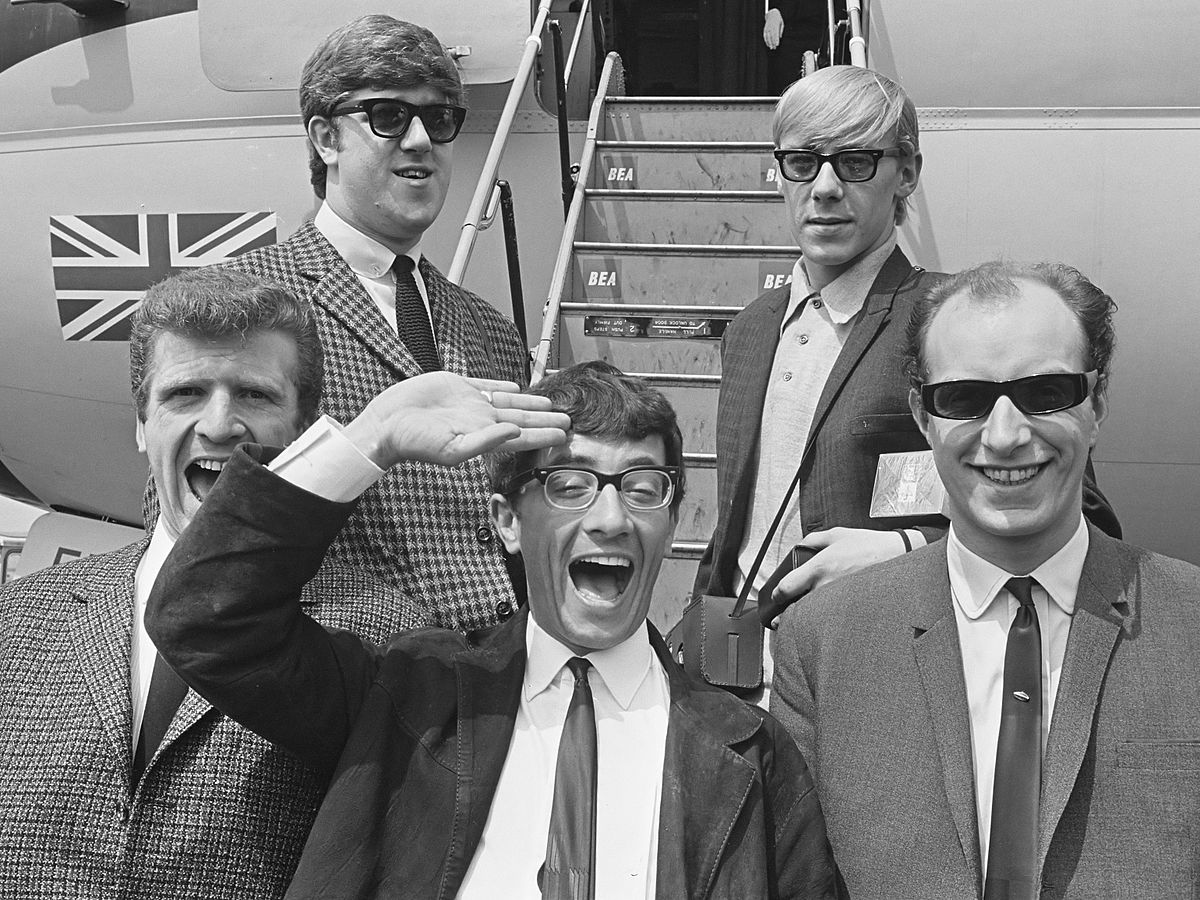
Freddie and the Dreamers were an English band famous for their string of hits between May 1963 and November 1965. Their secret weapon? The comic chaos of lead singer Freddie Garrity—just 5-foot-3 but bouncing wildly across the stage, arms and legs flailing in full showman mode.
Their biggest hit, If You Gotta Make a Fool of Somebody (1963), climbed to number 3 in the UK charts. But at the same time, another “Freddie” — were dreaming up a far darker hit. A tune that would take nearly 50 years to explode: the 2007 global financial meltdown. This crisis threw millions out of work and wreaked irreversible damage on economies and lives worldwide. Enter the University of Freiburg, a European research hub where Freddie (Friedrich) August Hayek began shaping his neoliberal economic theories.
By 1984, Hayek had been honoured by Queen Elizabeth II, on Margaret Thatcher’s recommendation, for his “services to economics.” The U.S. followed suit, awarding him the Presidential Medal of Freedom. Revered by followers as one of the greatest modern economic thinkers, Hayek left a deep ideological footprint.
In his essay Why I Am Not a Conservative, Hayek slammed traditional ‘one nation’ conservatism. Post-WWII, this moderate wing embraced social consensus on issues like employment and housing. But Hayek dismissed it, warning, “conservatism is only as good as what it conserves.” His message was a call to shake up centre-right parties and reject old compromises.
Once a leftist, Hayek now fiercely opposed government economic planning as a threat to freedom and a barrier to free markets. In 1974, the Centre for Policy Studies was founded by Sir Keith Joseph and Margaret Thatcher to promote his free-market ideas—the birth of neoliberal politics, with Hayek as its first director.
In 1975, during a visit to the Conservative Research Department, Thatcher stunned party aides by slamming Hayek’s Constitution and Liberty on the table, declaring, “This is what we believe in.” Sir Keith Joseph later admitted he only fully embraced Conservatism after 1974, acknowledging the profound shift underway.
Over the next decade, ‘one nation’ conservatives were sidelined, replaced by Thatcher’s hardline neoliberals. Even when Michael Heseltine helped end Thatcher’s reign, the damage was done—a quiet Conservative coup with consequences far beyond party politics.
Across the Atlantic, Hayek’s influence took hold at the University of Chicago (1950-62), alongside economists like Robert Fogel and Milton Friedman. Fogel infamously argued that slave owners treated slavery as business and slaves were better off than northern industrial workers—a controversial, cold calculation based on plantation records.
Friedman advised Reagan and Thatcher, and even Chile’s brutal dictator Augusto Pinochet, whose regime tortured and killed thousands.
Together, Hayek, Fogel, and Friedman forged the backbone of neoliberal policies in the UK and USA post-1979. Their obsession with unregulated markets is summed up by Hayek’s chilling claim: “free choice is to be exercised more in the marketplace than in the ballot box.” For him, markets trumped democracy.
This toxic trio’s dogma ignored the realities of everyday life, laying the groundwork for today’s economic chaos—deregulated banks and stock markets running wild, greed supplanting productive industry, replaced by complex financial derivatives that serve only the wealthy elite.
When disaster struck, governments flung open the doors to bail out the rich—an obscure form of socialism for the privileged few—while workers faced global competition and widening inequality.
The UK’s “Big Bang” on October 27, 1986, symbolized this shift: deregulating financial markets, abolishing fixed commissions, and unleashing new financial products. Money flowed freely—home loans, credit, refinancing—but the nation stopped making things. Public assets were sold off in privatizations, effectively selling what we already owned back to us.
The 2011 U.S. Senate Levin-Coburn Report blamed the 2007 crash on risky financial products, conflicts of interest, and regulatory failure. Yet no government dared challenge the neoliberal orthodoxy laid down by Hayek, Friedman, and Fogel. Even Labour under Tony Blair embraced it, championing the same market-driven framework.
That worked—until the money ran out.
Now, as we face a new dawn, the question is: can we break free from this cycle? Can we truly change the rules instead of remixing the old hits? Because no one needs another version of If You Gotta Make a Fool of Somebody blaring through the modern day X Factor of economic folly.
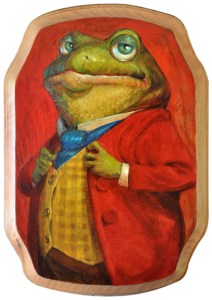 I don’t recall his name, but it was New Years Eve 1998, the comedian walked on stage and was warmly welcomed. His opening gag, “Scotland is celebrating tonight….Lena Zavaroni has had a shit.” His comic timing was impeccable. The room filled with equal bouts of laughter, gasps and groans. It’s a gag that has stuck with me. Not because of any comic value, but its cruelty, given it was common knowledge that Zavaroni, a child star of the 1970s, had been suffering from anorexia since her teenage years and within a year of this gag the 35-year old Zavaroni was dead. The only thing I took heart from that night was the thinning audience seeking refuge in an adjourning bar where it was concluded the comic was boring, a one-shot pony, no depth and no charisma to manage an audience beyond aiming to shock. Years later 3 things often cross my mind from that evening.


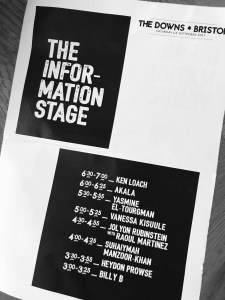 So what is to be done as we sit in self-imposed ignorant bliss, knowing the causes, but claiming to be ‘powerless’ to do anything? Being powerless can, of course, be a convenient excuse and one that in its worst condition seeks self-reflected pity on oneself. The cold reality is that some people vote to be powerless. The first step in demanding change is the realisation that you are not powerless and by actually doing something, no matter how little, you become a small, but integral part of a social movement and movements change things on a big scale. The words ‘political struggle’ in one of the wealthiest economies, had until recently, become an almost embarrassing term to use given the abundance of riches at our disposal. It is clearly back on the agenda for a younger generation who are quite rightly increasingly restless and angry at the inheritance being offered to them by a tired and self-imposed ‘powerless’ older generation. While government (nationally and locally) is blindfolded in a downward spiral of spin, apportion blaming and rebranding their diminishing resources as new. Informal networks of self-motivated people armed with nothing more than compassion and love are seeking solutions. On one hand, a growing number of people are not prepared to ‘walk on by’ and ignore the injustice staring them in the face and on the other hand young people are increasingly motivated to get involved in direct-action and structured politics. It’s too early to say if this is a fad and it may suffer the relentlessly grind wheels that have often warm many a good person down, but positive seeds have been sown.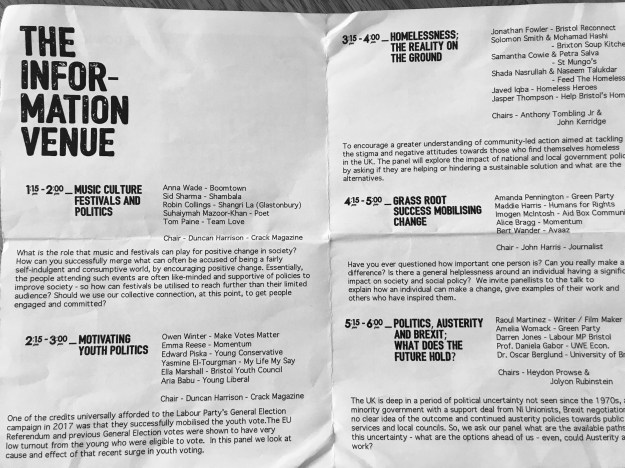
 29th April 2017 I was asked to facilitate a community session for the Mayor of Bristol (Marvin Rees) and Kerry McCarthy MP. The localised issues raised at community engagement sessions can often be listed beforehand housing, transport, education, fly-tipping, but nesting amongst these issues was the ongoing ramifications of Brexit. The audience while not large certainly reflected the diverse nature of opinion concerning the Brexit debate. What became clear during the session was that when politicians listen and engage with the fears and concerns of ordinary people a more considered debate takes place, which in turn helps forge a more objective understanding of the complex issues that are often presented in simplistic headlines. My lesson from facilitating this session is that we need to develop ways of breaking down the often perceived barriers between elected representatives and the general public.
 I took some time out to read the Gender
 Irregular Frequencies