It was a town arranged from leftovers, a row of second-hand shops dealing in third hand remains: cracked mirrors still holding the blur of strangers, dead radios, suitcases with broken clasps, wedding china browned at the edges, winter coats carrying the stale shape of vanished shoulders.
Even in daylight the street looked handled too often, worn thin by weather and repetition, as though every surface had been thumbed by generations of disappointment. People moved through it with the dull vigilance of those who had learned to expect little, pausing to point out cracks in the pavement the way farmers inspect bad soil, each split another small prophecy. The place felt abducted from itself—gagged, blindfolded, wrists cinched tight, shoved into a rusted shipping container and sent out toward Somalia, abandoned somewhere between departure and arrival, forgotten by whoever signed the papers.
A shop called Fun and Games stood near the bus stop, its sign sun-peeled and grinning above a window of warped board games, faded toy guns, and dolls whose eyes had clouded to the colour of old milk. Never had a name promised so much and delivered so little; even its doorway looked apologetic, a narrow mouth breathing out stale floor and electrical dust. The double yellow lines along the road did not forbid anything; they tempted, two tired strokes of paint inviting petty trespass, small acts of surrender, the kind committed by drivers too bored to care and wardens too defeated to enforce consequence. Wheelie bins lined the kerb in patient formation, lids half-open, solicitous as prostitutes selling their wears, their bodies offering up the sour breath of peelings, lager cans, and damp newspapers.
Speech came hard here. Conversations began, stalled, restarted; words dragged behind mouths as though each syllable had first to be hauled through mud. Laughter, when it surfaced, sounded borrowed and quickly regretted. The hotels looked like hostels pretending to dignity—peeling facades, net curtains browned by nicotine, entryways lit with that weak yellow light that belongs to places rented by the week. Faces appeared behind upstairs glass, pale and watchful, not curious so much as stranded, each pair of eyes carrying the same small hunger: not for company, not even for escape, but for somewhere the day might loosen its grip. By late afternoon the whole town seemed to lean inward, as if exhausted by the labour of remaining upright, waiting for darkness to hide what daylight had exposed.
Searching for food and coffee, I moved between places that seemed less open for appetite than for shelter, each doorway offering its own version of temporary relief.
In The White Horse the smell of stale ale hung low beneath the lights, thick enough to wear, while men nursed pints as though time itself had to be diluted before swallowing. Shoulders rounded inside heavy coats, their coughs starting up in rough succession like old engines failing—deep, mechanical, stubborn, each one sounding as though it had been dragged up through decades of smoke and bad air.
Dogs lay at their feet with the patience of creatures long resigned to waiting, collars slack, ears twitching only when a voice rose above the room. Talk moved in bursts: football, weather, blood pressure, lives condemned with the brittle certainty of men testing ice before stepping onto it, every opinion sharp enough to fracture if pressed too far. The laughter came hard and short, cracking across the bar before falling back into the low amber murmur of glasses, coughs, and old grievances.
I looked at the menu and left, crossed the road instead and headed to towards the corner coffee shop, which I had initially ignored, It faced The Old Town Hall, where I am working for the day.
The coffee shop itself was one of those regional franchises built on the performance of innocence—bright menu boards, apologetic pastries, chairs arranged to suggest welcome—yet carrying the faint corporate fatigue of somewhere copied too many times to feel local and too cautious to possess character. Its windows ran the length of the right-hand side, filmed with fingerprints, strains of rain drizzle, and the slow sediment of passing traffic, each pane clouded as though transparency had become an unnecessary luxury, or perhaps a liability.
The door sat dead-centre, opening onto warmth that smelled faintly of burnt espresso, milk, and old upholstery. Inside, sandwiches waited behind glass with a weary look, while cakes leaned under plastic domes like minor exhibits in a museum of stalled indulgence. Even here, searching for something simple—a plate, a cup, a reason to sit—the town made appetite feel like negotiation, as though hunger itself had to pass through a layer of hesitation before being served
“Americano and latte,” one of the women behind the counter called out, her voice cutting through the low mechanical hiss of steam and crockery, then hanging there for a moment, waiting to be claimed by whoever still recognised themselves in the order.
An old man stirred from his chair with the delayed caution of someone long accustomed to his own body resisting instruction. His hearing aids sat tucked behind his ears, though they were about as discreet as a motorway pile-up—small flesh-coloured devices that only emphasised the effort of concealment, like pretending age might be edited rather than endured.
He shuffled to the counter, shoulders pitched forward, hands already preparing themselves for the tray before it reached him, lifting it with both palms as though the cups required negotiation. The journey back to the table took concentration: each step measured, each saucer trembling faintly against porcelain.
His wife waited opposite, hands folded, coat still buttoned despite the heat inside, her face carrying that fixed patience learned over decades of sitting through the same afternoons. He lowered the tray between them, took his seat, and she gave him only a dull nod—an acknowledgement so practised it had shed all ceremony. They said nothing. No need, perhaps. Silence sat with them like a third companion, familiar and undemanding, while their lives resumed exactly where they had paused: as they had yesterday, and the day before that, and all the quiet days before those—without surprise, without urgency, without any visible expectation that the next hour might offer something different.
Three young women in their customary black moved behind the counter with the practised rhythm of those who could work while thinking elsewhere, their conversation slipping between orders, milk jugs, receipts—half-finished sentences about nights out, cheap flights, someone’s cousin in another city, fragments of imagined departures assembled between the steam and the clatter of cups.
They spoke of adventure as though referring to a country none of them had yet reached, somewhere beyond the machine hiss, the rinsed spoons, the endless repetition of names written on cardboard cups. Overhead, Billie Holiday hovered low through the speakers, her voice thin but insistent beneath the muttering of customers, carrying that bruised intimacy that made even ordinary air feel burdened with memory.
“Can I help you?” the eldest asked—perhaps mid-thirties.
“Could I have a large latte, extra hot, and an egg and cress sandwich please?”
By then I had already noticed how often she smiled: sometimes naturally, sometimes with the trained reflex of service, sometimes with the unmistakable effort of someone placing expression between herself and whatever the day had already done to her.
It was the sort of smile that arrived quickly and left carefully, as though measured for effect.
For a moment I wanted to ask what had preceded this—what ambitions once occupied her before she learned the grammar of orders and politeness, before mornings became receipts, lids, foam, and apologies—but the thought felt intrusive, almost arrogant, as though curiosity itself could become a kind of trespass. Who was I to demand biography from someone handing me coffee.
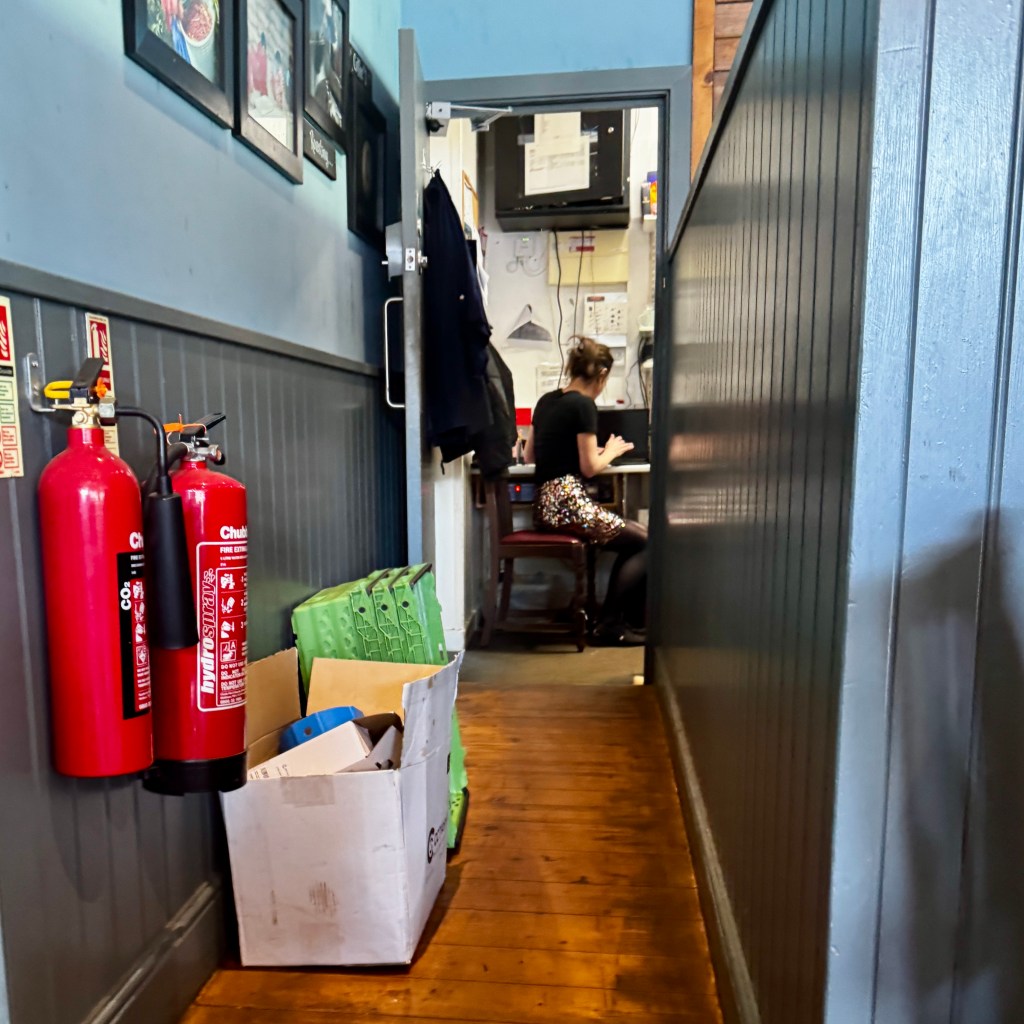
She turned to the machine, and only then did the detail appear: beneath the black apron, pulled tight at the waist and double-knotted with practical force, a sequin skirt caught the light. Dark purple and blue sequins flickered in the narrow gap where the apron parted, gathering the halogen glare and throwing it back in fractured flashes—small deliberate acts of brightness beneath uniform black. It felt less like ornament than declaration: a quiet refusal to disappear entirely into the function required of her, a small insurgency stitched into ordinary fabric, demanding that something private remain visible.
When she turned back, I smiled and thanked her. She smiled in return, and for the briefest second the expression altered—something almost imperceptible loosening at the edges, enough to suggest a life running parallel to this one: sunlight on skin, laughter without interruption, a slow walk beside the Seine, departure boards, foreign rooms, perhaps a lover who read poems badly but earnestly, someone reckless enough to believe devotion could alter geography. The thought came and vanished in the same instant, swallowed again by the next order, the next cup.
I paid with my phone, took the tray, and found a seat alone in the corner where no one would need anything from me. I switched off my hand-held radio and let the world close in—steam settling into the room, cutlery striking crockery, chairs dragging, the old couple still saying nothing, and outside the blurred windows the town continuing its slow rehearsal of itself, as if nothing here expected rescue and yet each face, in its own private way, remained faintly alert to the possibility.
As I found my seat, two police cars tore past outside, sirens flaring blue urgency across the stained windows and drowning the room in borrowed alarm. For a few seconds everything inside faltered—the hiss of the machine, the scrape of cups, even conversation itself—as every head turned instinctively toward the glass, each of us attaching our own private narrative to whatever emergency had just split the afternoon open.
Somewhere nearby, somebody had become the centre of consequence: a fight, a collapse, a theft, a body, a domestic argument swollen beyond containment. By Monday it would be reduced to six paragraphs on page six of the local paper, padded with police statements and half-facts, then repeated online beneath photographs of cordoned pavement and speculative comments from strangers certain they understood what had happened.
The sirens faded quickly, but their disturbance lingered, leaving behind that faint communal disappointment that nothing visible had followed.
There is something quite telling about a woman who reads hardback books—as though the object itself announced resistance to distraction. She sat two tables away, absorbed, her glasses low on her nose, a green dress falling to her ankle, tan brogues placed squarely together beneath her chair. Nothing about her invited interruption, yet nothing seemed accidental either. She carried the air of someone who had long ago negotiated a truce with solitude and learned how to occupy it without apology.
Not loneliness exactly, but a chosen arrangement: a life edited to manageable terms after enough failed attempts at fitting elsewhere. One imagined years of compromise discarded, expectations refused, and the slow hard labour of deciding that if affection or companionship arrived now it would do so under conditions she had written herself, clauses intact, revisions closed.
Then You’re My Best Friend drifted through the sound system, and with it came the odd private violence of recognition. A song crossing decades in a few opening bars, collapsing years without warning. It returned me to the awkward brightness of youth—to first kisses conducted with more hope than knowledge, the startled electricity of touching a breast through thin fabric, the cautious ascent of a hand along a girlfriend’s thigh before her fingers closed over my wrist and stopped the gesture with practised certainty, not angry, simply firm, as though rehearsing boundaries neither of us yet understood.
Those moments repeated themselves often enough to become their own education: desire checked, resumed, checked again, adolescence learning restraint through embarrassment.
I found myself wondering, as I sometimes do, what became of her—what face age had drawn for her, whether she still laughed the same way, whether memory had preserved me kindly or not at all. Once or twice I had searched for her online, scrolling through names on FaceBook, convinced for a moment that recognition might survive a changed surname, but no face had declared itself, no certainty arrived. Perhaps she existed there under another life entirely, or perhaps some people remain truest only where memory leaves them: half-lit, unfinished, always just before departure.
The woman who had perhaps learned the discipline of escape stood at the counter with both hands folded around her purse while she ordered, her voice low, almost careful, as though even here volume might count against her. Her clothes were regimented into caution: sleeves buttoned, collar neat, skirt falling without concession, every choice arranged to reveal nothing, advertise nothing, invite no unnecessary glance.
There was something deliberate in the way she occupied herself, as if even the act of standing still had been rehearsed under scrutiny. This, I imagined, was her sanctioned hour of freedom folded into the ordinary excuse of groceries and errands—the permitted interval between obligations, small enough to pass unquestioned yet large enough to breathe inside.
When her drink arrived, she carried it to the table nearest the window, choosing a seat that allowed her both visibility and warning. She did not settle so much as station herself there, posture alert, gaze repeatedly lifting to the street with the vigilance of a soldier assigned to a quiet checkpoint where danger rarely announces itself but is never entirely dismissed.
Each time the door opened her face altered almost imperceptibly: not panic, but calculation, the old habit of measuring who entered and whether their presence altered the room. Worry sat plainly in her expression, not dramatic, simply worn in—the kind that had been practised often enough to become part of the face itself. Yet beneath it there was also something faintly ceremonial in the way she held the cup, as though this coffee marked a private observance, a modest celebration of surviving another week unnoticed.
I wanted to believe she kept money hidden somewhere no one thought to search: folded notes tucked inside a rusted biscuit tin at the back of a cupboard, beneath sewing things or expired receipts, a private arithmetic of departure assembled coin by coin.
I wanted to imagine that at night, when the house finally thinned into silence, she lay awake with her phone turned low, listening again and again to Leaving On A Jet Plane sung by John Denver, not because she mistook the song for rescue, but because repetition gave shape to a possibility: that one morning the hour of freedom would lengthen, the groceries would remain unbought, the cup unfinished, and the seat by the window empty for reasons no one could immediately explain.
A white man sat alone far end of the cafe: jeans pulled tight beneath a large belly, bald head catching the flat interior light, blue T-shirt stretched across a body that looked as though time had arrived early and settled heavily. He kept stretching his back in short, irritated movements, then folding his arms again across his chest with a kind of practised defiance, a posture that tried to suggest indifference but could not quite conceal the undertow beneath it—something nearer despair, or exhaustion hardened into habit.
He was probably years younger than me yet had spent those years with such determination that he seemed to have sprinted toward age, arriving early through some private alliance of cigarettes, bad sleep, disappointment, and the slow corrosion of routine.
He watched the room the way some men watch weather: alert to changes, suspicious of interruption. His gaze moved from the counter to the door, to the woman with the hardback, to the old couple, then back again, until now and then it landed on me and stayed there a fraction too long.
Each time our eyes met there was that brief, unspoken testing—two strangers measuring one another without admitting to it, each deciding what sort of life the other might have carried in. His stare had judgement in it, but not the clean kind; something angrier lay below, banked and waiting, like heat trapped beneath volcanic stone, never erupting, only radiating upward in faint, constant pressure.
For a moment it crossed my mind that he knew exactly what I was doing: that he recognised the writer’s theft in prolonged looking, understood that observation can feel like trespass, that a stranger’s attention may strip a person more efficiently than conversation ever could. It felt possible he knew I had already begun making him into language, gathering the clues of him—the crossed arms, the watchfulness, the silence—as though his vulnerabilities might be kneaded into shape like putty if only, I stared long enough. But cruelty has never interested me; whatever else writing takes, it ought at least to know when to step back. So, I left him his silence.
After a while he stood, tugged awkwardly at the waist of his jeans to relieve himself of discomfort no dignity could disguise, then went outside and lit a cigarette. Out there he changed slightly. People passing acknowledged him with nods, brief words, small exchanges that opened his face just enough to admit a smile—nothing deep, only those basic transactions by which human beings confirm one another’s existence without obligation.
He answered each greeting with surprising softness, smoke lifting past his head while traffic moved behind him. Then he came back in, ordered another drink, and returned to exactly the same seat, resuming the same folded posture as though some invisible hand had placed him there again. No book, no newspaper, no phone—just stillness, deliberate and faintly ceremonial, like a broken Buddha left in a garden gone to weed, weathered but stubbornly upright.
Here, I thought, was a man who had almost certainly loved and been loved, who had known at some point the ordinary justices of life: shared bills, Sunday meals, arguments over nothing, laughter in kitchens, perhaps a child asleep upstairs, perhaps grief delivered by phone, perhaps papers signed in a solicitor’s office under fluorescent light.
A divorcee, a widower, or simply a man whose whole bearing now suggested caution so ingrained it resembled warning: keep clear, do not mistake stillness for invitation, do not offer what you cannot sustain. And yet even in that guardedness there remained something else—not hope exactly, but the residue of someone who still came out each day to sit among others rather than disappear entirely, which is, in its own modest way, a kind of refusal.
A young couple drifted into the shop, hands clasped so tightly it was almost a declaration. She tugged at her top constantly, a nervous, unconscious invitation, the fabric shifting to reveal more than the day demanded. He followed her with a gaze that was unguarded, unashamed, worshipping her, I could feel sex radiating from him—a heat focused, blunt in its clarity, fixated on the curve of her body, the intent clear before words were ever spoken.
They ordered sugar-laden drinks, syrupy, bright, indulgent, the kind made to dazzle the tongue and fuel the nerves of those who believe life is something to be consumed in excess.
Both seemed built to endure it, to weather the excess of sweetness and laugh it off, to let the rush of caffeine and sugar be nothing more than the background to their larger intoxication: the thrill of being young, untested, alive. They laughed freely, leaned into each other’s space, mouths brushing shoulders, hips nudging subtly, as though every touch, every glance, was a rehearsal for life itself.
Their bodies moved with the confidence of inexperience, knowing neither restraint nor consequence yet. Moments seized in back seats of cinemas, laughter spilling over the dark, hands exploring forbidden maps of skin, the world outside reduced to a blur of streetlights and passing cars. For them, nothing beyond the shop mattered—not bills, not worry, not tomorrow.
To be young was to be fearless, to grip happiness as though it were tangible, something inherited at birth, a god-given right to be owned and displayed. They existed in the perfect clarity of now, every breath a claim, every kiss a small revolt against the slow, creeping weight of adulthood.
A family of four moved into the shop with the quiet authority of those who already know their place in the world. She led, a mother with curls of blonde that bounced with every step, her right arm traced with tattoos of butterflies, each winged creature a fleeting mark of individuality.
She carried herself with a slow, deliberate voluptuousness, the beautiful curves of a mother, that turned space around her into something warmer, heavier, more alive. He followed, shoulders back, chest open, a long grey beard tapering to points that caught the light with quiet dignity. He might have been ten years her senior, but the age carried weight rather than decline—commanding respect, envious attention, even mine, without ever asking for it.
Their children trailed politely, eyes curious but mannered, questions posed and answered with the natural rhythm of those raised in care, discipline, and affection. No theatrics, no forced smiles, no calls for attention—these were parents for whom the act of being good was inseparable from the act of existing.
Authority here did not need to be declared; it radiated through posture, tone, and the subtle rhythm of the family moving together. They ordered, collected, and returned to their table with the quiet certainty of people who had long ago learned that respect is earned in the small motions of life: a hand on a shoulder, a gentle correction, a shared glance that held understanding.
Around them, the shop seemed to bend subtly, approvingly, as if the air itself acknowledged competence wrapped in warmth, and for a moment the ordinary routine of cups, coffee, and conversation paused to accommodate something almost ceremonial, a family simply being itself.
I say goodbye to the lady behind the counter, with a sequin dress and make my way back to the venue.
It was close to eleven when The Delines slipped into The Oil Rigs At Night, that slow, bruised opening carrying across the hall with the weary certainty of a confession already made too many times to be withdrawn. It had always struck me as one of the finest songs ever written about a woman leaving a man—not dramatic, not vindictive, simply resolute: tenderness sharpened by the knowledge that departure, once chosen, becomes its own kind of mercy.
From behind the mixing desk, I was already half elsewhere, listening and dismantling at the same time, my head moving ahead of my hands—cables already coiled in thought, DI boxes, mic stands lowered, lids imagined closing over foam-lined compartments, the van outside waiting like the final sentence of a long day. The music still filled the room, but mentally I had begun the derig before the last chorus had even found its shape.
Out of the corner of my eye, I caught sight of the voluptuous woman from the coffee shop, now without the four children who had earlier orbited her with such easy discipline. She stood near the back with her man pressed close behind, his arms around her waist as though the space between them could not be risked, as though even oxygen required negotiation before it passed.
He held her with that absent-minded certainty some men carry when affection has become instinct rather than performance. Her head rested back into the hollow beneath his chin, and together they swayed almost imperceptibly to the song, her body yielding just enough to trust his balance. Nothing theatrical, nothing displayed for others—only that small, private rhythm couples acquire when years have worn away the need to prove themselves.
I took the first box down the side stairs and out into the night. The air had sharpened since dusk; cold enough now for breath to show. As I crossed toward the van, a car slid up beside the kerb and paused, waiting for two pedestrians to cross. Bass thudded so heavily inside it the side windows trembled with each beat, the sound leaking through the metal like pressure escaping a sealed room—insistent, repetitive, determined to announce itself to anyone within range.
The car itself was all effort: polished bodywork, fitted spoiler, cheap alloys, the usual vocabulary of speed attached to something built more for appearance than velocity. Behind the wheel sat the young man from the café, his hands high on the steering wheel, face lit briefly by dashboard blue. Beside him the young woman—sugar-drunk bright, alive in every movement—nodded her head to the rhythm, laughing at something he had said. Their windows were up, but youth travelled easily through glass: that conviction that night belongs to you, that consequence remains abstract, that every road opening ahead is invitation rather than warning. He revved once, the crossing cleared, and they shot off into the dark, exhaust hanging briefly behind them like punctuation.
By the time I brought the second box out, laughter came shrieking up the pavement before the women themselves appeared. Five of them, moving in loose formation, all bright voices and bare shoulders despite the cold, singing fragments of 90s disco as though the street itself had become an extension of the night they intended to exhaust.
Pink sashes crossed their chests—Kate’s Hen Party printed in glittering capitals—and one of them, leading the procession with the solemn absurdity such things demand, carried a male blow-up doll under her arm, its plastic limbs knocking against her hip. Their skirts were too tight for comfort, heels unsuited to the uneven pavement, makeup beginning to soften at the edges under drink and weather. Then the nearest one turned her head, and I recognised the sequin skirt: dark purple and blue catching the streetlight exactly as it had beneath the café apron earlier that day. The barista, now liberated from coffee foam and paper cups, her friends laughing and singing hard. As she gripped the inflatable figure for balance. It seemed right somehow—that what had flashed in secret under halogen at noon now belonged fully to the night.
A taxi drifted past slowly enough for the rear seat to catch the streetlight. Inside sat the woman who had read the hardback book, her face turned to the window, features pale behind the glass, distant and suspended, as though already half removed from wherever she had spent the evening.
She looked not at anything in particular but at everything passing at once, her expression flattened by reflection until she seemed almost aquatic, like a mermaid transported badly inland and learning to survive behind glass. I smiled something between greeting and reflex. If she saw it, the taxi moved too quickly for her answer to arrive.
The third and final box was heavier, awkward through the shoulders, the kind that makes you aware of the hour in your spine and your age. Across the road, outside Wetherspoons on Park Road, the bald man from the coffee shop leaned against the wall rolling a cigarette with thick fingers that no longer entirely obeyed him.
His large belly pushed against the hem of his blue T-shirt; his balance had loosened into something uncertain. He cupped the cigarette from the wind, lit it, inhaled, then stayed there for a moment with one shoulder against the brick as if checking whether the wall intended to remain trustworthy. When he finally moved, he did so in a slow diagonal toward the town park—wobbling, correcting, muttering to himself, a private ruin making its negotiated way home through the dark.
Back inside, the hall had emptied into practical silence. The audience were gone, applause already memory. Musicians packed guitars into hard cases, folded leads, checked pockets for tuners and capos. A snare drum tightened once, then stopped. Someone laughed softly near the stage. The venue manager moved through the room with the tired efficiency of habit while I checked what remained to be lifted in the morning.
One final look at the stage, then the lights went out in sections, darkness arriving from the corners inward until only the stairwell glowed. She armed the alarm, locked the doors, shook my hand, wished me good night, and disappeared into her own end of the evening.
Keys in hand, I moved toward the van. It was then I noticed movement in the coffee shop doorway opposite: slight, still, almost folded into shadow. Something in the posture stopped me—an instinct older than thought, the body recognising distress before the mind names it. I took a few steps closer.
It was the woman who had spent the afternoon by the window, the one whose freedom had seemed measured in stolen minutes and careful glances. Coat buttoned to the throat, collar neat, skirt falling with the same severe discipline as before. Even now, every part of her looked arranged to reveal nothing, advertise nothing, invite no unnecessary question.
She raised her head.
The bruise on her cheek caught the streetlight.
Fresh, red-blue, recent. There were scratches along one hand, thin and angry, and her eyes had that swollen brightness crying leaves behind.
“Are you alright? Can I help?”
For a second she tried to answer and nothing coherent arrived, only breath catching against whatever words had become too large to carry.
“Can I phone somebody for you?”
She bent, lifted the suitcase, and when she straightened there was something newly set in her face—not calm exactly, but resolve hardened enough to stand upright inside fear.
“I’m leaving on a jet plane,” she said.
At that exact moment a taxi pulled up behind me, engine idling, indicator clicking into the night like a second hand marking the moment she stopped belonging to wherever she had come from.
 Irregular Frequencies