 “I’m enjoying the raw nature of the work; there is no hiding given we are the front door for many people.” Tess, the ex Cardiff University Law Student tells me. “The learning curb has been quick, and until I got involved, I did not fully appreciate the patience and time it takes to help somebody to turn their life around.” Tess supports the Independent Futures (IF) Group, which acts as a bridge between those with lived experience or find themselves enduring homelessness, substance misuse, at risk of reoffending, or mental health concerns with those agencies funded to guide them out of the world they inhabit.
“I’ve just started to volunteer here. I want to make friends, build up my confidence and find work. I’m starting to make good progress now” Ed tells me who moved to Bristol 3 years ago from the neighbouring city of Bath. “We need more places where people are not being pigeonholed, labelled or marshalled towards somebody else’s answer.”
Control and power and who holds them seem to be a central value running through Bristol Reconnect. These are the types of concepts that are difficult to measure, and ones that often get left behind when charities and voluntary sector groups are forced to sniff out funding from an ever decreasing pool of tightly defined contracts.
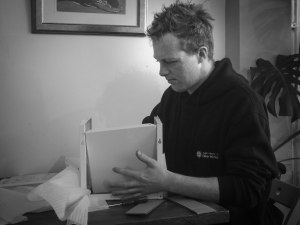
On the ground floor cafe, a volunteer is cleaning and testing the coffee machine while another is tucked away in a corner focused on the task of assembling a donated storage box. Opening times at the cafe fluctuate given the reliance upon volunteers. On the 1st floor is a community room, which is available for hire. Located at the rear of the building is a pleasant garden space, recently upgraded as part of a TV challenge programme. In an ideal world, these assets would be contributing income towards the group’s upkeep, but like most small community groups seeking to survive beyond the realm of grants it will take time, but time is not a luxury for group’s like Bristol Reconnect. I ask about resources and funding, but it’s met with a deep sigh and redundant shrug of the shoulders. There is, of course, a new settlement urgently needed in this country about the style, nature, and provision of welfare that we are prepared to pay for given the inherent failures of the current system. But whatever the cause or the potential solutions this is where we find ourselves today, and some people can’t wait, “We either do something, or we do nothing, and doing nothing is unacceptable” Jonathan, the Chief Executive, cook, cleaner, dishwasher, counsellor and crisis manager at Bristol Reconnect tells me.
Bristol like most urban cities in the UK is coming to terms with the impact of austerity. The lag between central government budget announcements, policy delays and the impact on the ground regarding frontline services is catching up for many in the city. The mythology of so-called efficiency savings and other magical accountancy terms have not shielded services against the depth of cuts needed to balance the books. As local campaigns gather pace against the loss of frontline services like libraries those most vulnerable are more unlikely to able to raise their voices. The homeless, vulnerable adults and children with complex care needs and the elderly. This role often falls to groups like Bristol Reconnect, who are increasingly becoming stretched to the point of breaking. The question increasingly being posed is, “what type of local council do we require in Bristol beyond austerity?”
 There is a sense of unity with those facing the loss of their jobs in local government and that central government funding cuts are spitefully engineered to punish, strip away dignity and they are ideologically driven to erode further welfare funded by general taxation.
“The way housing is provided makes it difficult for families to live together in neighbourhoods now. The support you would normally get from your grandad, uncle or another member of the family is no longer there, so people look towards institutions like the council. Even before the cuts my experience was mixed and even accessing the service was difficult.” I was told by one person who wanted to remain anonymous.
Local council’s, like Bristol City Council, have traditionally been the significant investor in local charity and community sector groups. “There is little you can often do to change how a large organisation works, so small self-help groups become increasingly important, which poses the question if the likes of the council are struggling to do things with their diminished resources how can we be expected do more without resources? It’s a very dangerous situation we are now entering. It needs a shift in mindset from everybody” say’s Aaron who along with Jonathan is one of the original instigators behind Bristol Reconnect. “We need to rebuild around communities rather than institutions. We will continue to try and explain this to larger organisations who have the clout to make a difference. We try to help them listen, but my experience is things don’t change because of the corporate-ness. It’s dehumanising as if we have adopted something out of the animal kingdom where the fittest survive and the reward is a contract to work with the most marginalised and vulnerable people in our community. The whole ethos is sick. The focus needs to be on reconnecting people.”
What I think Arron is getting at here is not necessarily what institutions seek to do, which is often laudable, but how they go about doing it. It seems to boil down to behaviours and recognising that working within a statutory institution will inevitably develop a specific set of behaviours, as working in the charity and community sector will naturally do. Any rejection of the Government’s policy of austerity cannot simply be about restoring what has gone before. The focus of rebuilding, if or when it comes, must increasingly be about the outcome, behaviours, connection, empathy, equity, etc. rather than simply rebuilding a specific institution. “Simply focussing on relations from a monetary perspective takes things away. Head and heart, depending which one you want to put first. I appreciate people need to get paid, but it’s about having the mindset alongside your responsibility. If you are obtaining a salary, then it provides you with the opportunity to think about others. Voluntary sector groups especially can get destroyed by chasing funding, which ends up determining what they do. There is a balance.” Aaron adds.
So, if there is an acceptance that core funding is difficult to access at the moment. What type of support do groups like Bristol Reconnect need to survive? After a thoughtful pause from those present the following ideas emerge:
- Help with redesigning the space we use to make it more efficient.
- Access to a small budget to help with the start-up phase.
- Business development throughout the initial shaky period.
- Volunteers willing to serve from trustee through to service delivery.
None of these issues, of course, are exclusive to Bristol City Council to help resolve, but “How about your local Council?” I ask. “Brokerage” comes the answer.“What do you mean by brokage? I ask. “Somebody who can navigate from within the council who understands how the public, private and charitable sectors work. They are able to facilitate exchanges, obtain and share things. For example, we needed some gear for the kitchen recently. We could spend time fundraising and then purchase stuff, but in a city like Bristol these things will be sitting idle in a charity, business or council storeroom somewhere.”
In times of strife and challenge, when strategy development becomes a comfortable blanket to hide under, it’s often the simple things that can sometimes become the most difficult to resolve. Why? If you want to find out more about Bristol Reconnect, or you may have something to offer? You can take the first step by clicking here: Stand Up and Be Counted.
SaveSave
SaveSave
SaveSave
SaveSave
SaveSave
SaveSave
SaveSave
SaveSave
SaveSave
SaveSave
SaveSave
SaveSave
SaveSave
SaveSave
SaveSave
SaveSave
SaveSave
SaveSave
SaveSave
SaveSave
SaveSave
SaveSave
SaveSave
SaveSave
SaveSave







 Somethings have explanations, some things take belief, while others just leave you pondering for a rational reason for them to exist. They capture a moment, like stars when they align. On this damp, chilly September morning in the corner of my kitchen, a corner where the plants do their best to thrive, of all these days, a blooming flower stretches out seeking the sky. It’s the last flower, my father planted before he died on the 3rd March 2017, which is exactly, to the day, 12 months after my mum had passed away. The significance of this solitary flower that blooms on this damp, chilly September morning is what causes the pause, as I make a breakfast tea and say happy birthday to my mum.
 In a decade peppered with cultural and economic change, the 1970s certainly churned out a vast array of musical genres. While TV sitcoms reflected the mundane of life there was also documentaries that sought out injustice and the mysteries of the world, (John Pillinger, The World in Action, Whicker’s World). In this national psyche emerged the oddity of Jake Thackray’s Yorkshire baritones penetrating the fray of well tuned southern accents, which still dominated broadcasting. My first memory of Thackray was as a young child during a magazine TV programme called That’s Life, a machine gun etiquette of consumer protection, light entertainment, performing dogs, funny shaped vegetables sitting alongside hard-hitting investigations into wrong doing. Thackray was brought up in a working-class family and enjoyed the pleasures of pale ale, rugby and pipe-smoking. After moving to Lille in France, where he taught English, Thackray became an unlikely disciple of French artists like Georges Brassen and Jacques Brel.


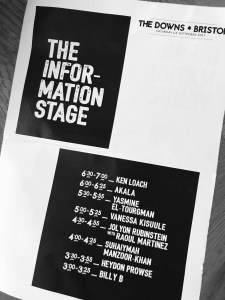 So what is to be done as we sit in self-imposed ignorant bliss, knowing the causes, but claiming to be ‘powerless’ to do anything? Being powerless can, of course, be a convenient excuse and one that in its worst condition seeks self-reflected pity on oneself. The cold reality is that some people vote to be powerless. The first step in demanding change is the realisation that you are not powerless and by actually doing something, no matter how little, you become a small, but integral part of a social movement and movements change things on a big scale. The words ‘political struggle’ in one of the wealthiest economies, had until recently, become an almost embarrassing term to use given the abundance of riches at our disposal. It is clearly back on the agenda for a younger generation who are quite rightly increasingly restless and angry at the inheritance being offered to them by a tired and self-imposed ‘powerless’ older generation. While government (nationally and locally) is blindfolded in a downward spiral of spin, apportion blaming and rebranding their diminishing resources as new. Informal networks of self-motivated people armed with nothing more than compassion and love are seeking solutions. On one hand, a growing number of people are not prepared to ‘walk on by’ and ignore the injustice staring them in the face and on the other hand young people are increasingly motivated to get involved in direct-action and structured politics. It’s too early to say if this is a fad and it may suffer the relentlessly grind wheels that have often warm many a good person down, but positive seeds have been sown.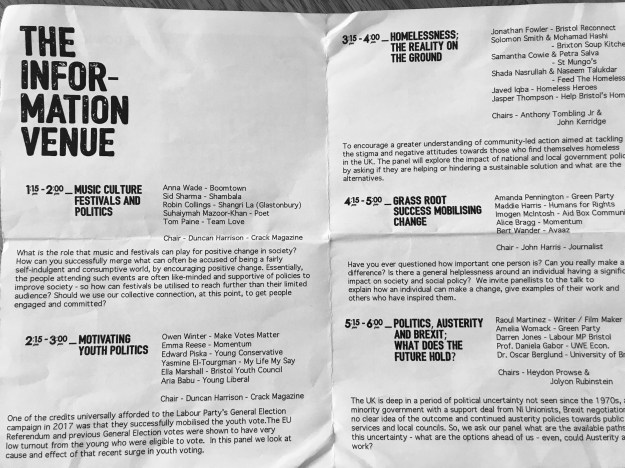
 Irregular Frequencies