Author Archives: John Kerridge

Unknown's avatar

About John Kerridge

I have a camera, drink tea and trip on untied shoe​ laces.

Oblivion – A Memoir of Love, Loss, and LightUntil life is done

By Héctor Abad Faciolince

Some books slip into our lives almost by accident. A glimpse of a cover on a dusty shelf, a fleeting mention in the footnote of another work, or a casual reference in conversation — and suddenly they are there, claiming space in our thoughts. I’m not entirely sure how Héctor Abad’s memoir Oblivion found me, but I am certain I will not forget it.

Before opening its pages, I knew neither the author nor his father, whose life — and death — form the beating heart of this 261-page work. Abad’s father, Dr. Héctor Abad Gómez, was a renowned medical doctor, university professor, and fearless human rights advocate in Colombia. In 1987, he was murdered — silenced by those aligned with the country’s wealthy elites, government, and military.

Yet Oblivion is far more than a political testament or an account of injustice. It is a luminous exploration of the knotty, tender, and often unspoken dynamics between father and son. Abad writes with grace and intimacy, weaving the personal and the political into something achingly human. The result is a book that is not merely about loss, but about the enduring presence of love and the stubborn beauty of those who choose to stand against darkness.

This is a memoir to be read slowly, to be savoured — a work that affirms the world would indeed be a poorer, dimmer place without people like Héctor Abad Gómez.

Walls Come Tumbling Down – Music, Politics, and the Sound of Resistance

By Daniel Rachel

Some books do more than recount history — they revive the pulse of an era. Daniel Rachel’s Walls Come Tumbling Down is one such work: a sprawling 500-page testament to the intertwined music and politics of Rock Against Racism, 2 Tone, and Red Wedge, charting a turbulent but transformative period from the mid-1970s to the early 1990s.

For me, these were not just historical movements. They formed the soundtrack to my own coming of age, shaping me from child to adult, both musically and professionally. Rock Against Racism sparked my political awareness; Red Wedge made me an active participant. Rachel captures this journey in a meticulously structured, linear timeline — part oral history, part cultural encyclopedia — that documents the key figures and pivotal events with the weight they deserve.

Reading it in today’s context, I could not help but draw parallels to the energy and urgency of Black Lives Matter. While much has changed since the overtly racist culture of the 1970s — a time when prejudice was not only tolerated but celebrated — the persistence of hate, both on the streets and in the shadows of social media, reminds us that progress is fragile.

Rachel’s book lands at a time when cities still reel from racially-motivated violence, when online platforms amplify ignorance, and when political leaders rely on fear and slogans to paper over complex truths. Walls Come Tumbling Down is not just a chronicle of past activism; it is a mirror held to the present, asking uncomfortable but necessary questions about who we are and what we stand for.

In the end, Rachel reminds us that while good intentions can inspire, only action changes the world. The music may have been the rallying cry, but it was — and remains — the movement behind it that matters most.

Public Nuisance – The Psychedelic Ghosts of ’69

The late 1960s was an era of kaleidoscopic shifts — psychedelia in full bloom, garage rock breaking through, and bands pushing the limits of sound as the world outside roiled with political unrest. It’s a period that’s been mythologised in countless films and books. But some stories remain in the margins, whispered rather than sung. One such tale belongs to Public Nuisance.

Formed in 1964, Public Nuisance began as a pop outfit, riding the same wave as countless garage hopefuls. By the decade’s close, they had sharpened their sound into a heavier, more psychedelic edge, sharing stages with the likes of Buffalo Springfield, The Doors, and the Grateful Dead. In late ’68 and early ’69, the band cut an album’s worth of material with heavyweight producer Terry Melcher.

Then history intervened. Melcher, having sub-let his Los Angeles home to Roman Polanski and Dennis Wilson of The Beach Boys, was caught in the dark aftershocks of the Manson Family murders. Polanski’s wife, Sharon Tate, was among the victims; Wilson had been socialising with Manson’s followers. The trauma drove Melcher into seclusion, shuttering his label and leaving Public Nuisance without a lifeline.

By 1970, the band was gone, their recordings shelved and unheard except by a handful of survivors from that drug-fuelled, free-falling era. It would take 35 years before their music finally surfaced — resurrected as Gotta Survive, a double-CD anthology that stands as both a time capsule and a testament to a band that might have been.

Public Nuisance never got their moment in the sun, but their belated debut still burns with the strange, vivid light of 1969 — a ghostly reminder that some of rock’s greatest stories are the ones that almost slipped away.

From the Ashes of Hope to the Rise of Populism

The 1990s were no stranger to bloodshed and greed, yet amid the chaos, there were flickers of progress — small seeds of hope that seemed, for a moment, to promise a better future.

1991: The Berlin Wall’s collapse triggers a domino effect, toppling authoritarian regimes across Russia and its former Soviet satellites.

1995: The world, united for once, confronts an environmental threat. The production of CFC gases — silent destroyers of the ozone layer — is banned.

1997: The IRA calls a ceasefire, paving the way to the Good Friday Agreement a year later, a rare and hard-won peace on European soil.

2000: The Camp David Summit gathers Israeli and Palestinian leaders in an attempt at reconciliation, the latest chapter in a long and bitter history.

These events, in different ways, underpinned a resurgence of social democracy that, for some, found its symbolic peak in the election of Barack Obama in 2009. And then — it turned to ash.

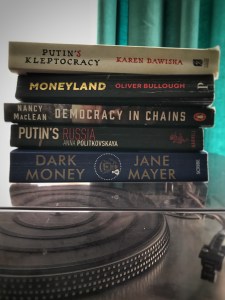
During lockdown, I sought to understand how we had arrived at our current moment. The geopolitical drama surrounding Russia and China added urgency, but what I found was not simply a tale of foreign villains. I read voraciously — five books that, in their own ways, peel back the layers of this era:

  • Putin’s Kleptocracy – Karen Dawisha
  • Moneyland – Oliver Bullough
  • Democracy in Chains – Nancy MacLean
  • Dark Money – Jane Mayer
  • Putin’s Russia – Anna Politkovskaya

Each opens a door for the inquisitive mind, though they make for uneasy reading. They reveal a pattern in which wealth buys power, power buys protection, and the rules are rewritten to safeguard the interests of a global elite.

Yes, there is ample evidence of corruption in both Russia and China. But the narrative that frames our predicament as a simple clash between “us” and “them” is lazy at best, willfully misleading at worst. This is not a danger born of Reds lurking under our beds; it is a creation of our own making. The roots stretch back long before the Soviet collapse or China’s economic rise.

The oligarchs of Russia and the medal-clad tycoons of the People’s Republic have simply claimed their seats at a table already set by Western plutocrats. Together, they form a new aristocracy — global in reach, united in purpose, and accountable to no one but themselves.

What can be done? We can start by recognising that their influence depends on our consent. And then, with clear eyes and a little courage, we can refuse to elect their paid agents. The world we inherit depends on the choices we make now — not in the corridors of power, but at the ballot box.

Cogs

Inside the Clockwork of Power: Huawei, Johnson, and the Global Struggle for Technological Supremacy

In horology — the precise study of timekeeping — the mainspring provides the energy, the ratchet stops the unwinding, and a series of wheels and cogs divide the motion into measured intervals. It is a delicate, interlocked mechanism, hidden from view yet essential to order.

Politics, too, has its own clockwork: a hidden interplay of forces, interests and manoeuvres. When Boris Johnson, freshly empowered after his 2019 election victory, decided to allow Huawei a role in Britain’s 5G network, the decision appeared to be the mainspring in motion — a calculated step towards technological progress. Within months, however, the mechanism was forced into reverse by a powerful combination of domestic opposition and international pressure.

The Huawei Reversal

In January 2020, Johnson approved Huawei’s involvement in Britain’s 5G infrastructure, despite the fact that another Chinese telecoms provider, ZTE, had been banned from the UK since 2018 over “national security risks” deemed “impossible to mitigate”.

The backlash was swift. Concerns over security combined with the strategic lobbying of American corporate and political interests. Six months later, on 14 July 2020, Johnson reversed course, ordering the removal of all Huawei equipment from UK networks by 2027.

The reversal came in a post-Brexit environment where the UK was struggling to balance two contradictory ambitions: securing new global trade deals while preserving as much as possible of the economic advantages of the EU single market.

A Prime Minister as Global Trader

Johnson imagined himself a dealmaker in the mould of a buccaneering Del Boy or a wartime Churchill — proud, defiant, and unencumbered by what he saw as constraints. But his decision on Huawei collided with the geopolitical realities of a world in which technological infrastructure is the front line of a deeper struggle: not just for state security, but for economic supremacy.

The Yuan and the Dollar

At the heart of this struggle lies China’s long-term challenge to the supremacy of the US dollar. By keeping the yuan pegged to the dollar, Beijing fuelled its export-led growth, expanding its share of global GDP and trade. In 2015, the IMF granted the yuan reserve currency status; it is now the world’s fourth most-traded currency, overtaking the yen, the Canadian dollar and the Australian dollar.

For some in Washington, Huawei’s global rise is not just a corporate success story, but part of a strategic campaign: to couple Chinese-built telecommunications infrastructure with Chinese currency dominance.

Technology’s Two Pillars

5G technology depends on two complementary pillars. The first — “single-purpose” providers — build the physical infrastructure: Ericsson (Sweden), Nokia (Finland), Samsung (South Korea), Huawei and ZTE (China). The second — “multi-purpose” providers — supply the software, data management and artificial intelligence that make the networks function: Cisco, Dell, Hewlett Packard (all US), and Lenovo (China).

Huawei, uniquely, straddles both spheres. With over $200m in annual government subsidies and $100bn in credit for customers, it can enter markets at a loss, undercutting competitors. It is this dual capability, coupled with Beijing’s broader economic strategy, that most alarms Washington.

The Campaign Against Huawei

Johnson’s January 2020 decision triggered an intense lobbying effort. One key player was the Heritage Foundation, a US conservative think tank with deep connections to the Trump administration and a long-standing hostility to Chinese influence in Western infrastructure.

The Foundation met senior UK officials and Conservative MPs to press for a reversal. Among those leading the domestic campaign was Iain Duncan Smith, a former Conservative leader with close ties to US political networks. In 2018, Smith declared share options in NLYTE Software, a UK company supplying data centre management software to Cisco — a direct competitor to Huawei in the “multi-purpose” sphere.

Other familiar names in the Heritage orbit included Liam Fox, the former trade secretary whose failed promise of “the easiest trade deal in history” with the EU remains a cautionary tale.

The Broader Question

Britain’s relationship with authoritarian states has always involved a selective blindness. Security concerns about Huawei did not prevent a Conservative-led government granting China General Nuclear Power a 30% stake in Hinkley Point C in 2012.

The Huawei episode revealed how swiftly technological policy can be swept into the currents of geopolitics — where corporate competition, national security, and diplomatic positioning form an inseparable tangle.

The Clockwork Lesson

The workings of a clock are intricate, interdependent, and largely invisible until something fails. In the same way, the machinery of global trade, diplomacy and technology policy turns behind closed doors. The Huawei affair exposed the fragility of Britain’s position — not just in its relationship with China, but in its attempt to navigate between the gravitational pulls of the world’s two largest economies.

When the mechanism jams, the damage is often done before the public even hears the ticking stop.