Tag Archives: music

No more heroes anymore

James Dean Doll

James Dean Doll

On July 23, 2011 singer Amy Winehouse was found dead in her London apartment at the age of 27.  During her short life, Winehouse accumulated a net worth of $10 million, but like so many other celebrities she may end up earning more money in death than in life. Dying young captures the eternal spirit of a musician and artist, which helps create a mythology that often projects the person behind their human fragility to one of almost god like status with fans increasingly desperate to be connected in some way with their deceased hero.

The first sign of this phenomena was actor James Dean who died in a car crash September 30, 1955 (aged 24). Dean’s major films identified him in roles like Jim Stark’s Rebel Without A Cause depicting the dilemmas of a teenager, who feels that no one, not even his peers, can understand him. During the 70s no self-respected adolescent facing the doomed prospect of being young would be seen without their James Dean t-shirt. Today James Dean merchandise is in abundance and fans can if they so wish reacquaint themselves with their hero via the James Dean doll for £25. Michael Jackson posthumously earned millions from music video marathons, radio airplay, and album sales immediately following his death. The dad of death merchandise goes to the proclaimed King of Rock n Roll Elvis Presley. who remains one of the most celebrated musicians of the 20th century. Commercially successful in many genres, including pop,blues and gospel, Elvis  is the best-selling solo artist in the history of recorded music. He died August 16, 1977 (aged 42). The King of Rock ‘n’ Roll has long earned money after his death, largely due to an immense portfolio of licensing and merchandise deals and Graceland admissions. Given the manner of the Kings death some of the mechanise should, shall we say is beyond contempt?

Kurt Cobain doll

Purchasing one of these dolls is like buying Courtney Love lifelong memberships to the NRA. (copy right Bill Hicks)

“You Know You’re Right” was written in 1993, making it one of the last known Kurt Cobain compositions. A studio version of the song was recorded at Nirvana’s final session, on January 30, 1994.  By 5th April 1994 Cobain was dead at the mere age of 27 following several attempts at suicide he finally succeeded. The recording became the object of much legal wrangling between Courtney Love and the surviving Nirvana bandmates Dave Grohl and Krist Novoselic. Grohl and Novoselic had wanted the song for a planned Nirvana box set, but Love blocked its release, and a battle over Nirvana’s legacy ensued. In September 2002, the lawsuit between Love and the surviving Nirvana members was settled, and it was announced that “You Know You’re Right” would arrive on a one-CD history of the band. What is not disputed is the business empire that emerged following Cobain’s death, books, films, posters and of course the obligatory t-shirt that is later years would also include Cobain’s suicide note. Fans may also want to purchase the Kurt Cobain doll with replicated rife, so to rein-act their heroes desperate final hours. Death of course does not stand in the way of the deceased artist contributing to new commercial venture. Several artists have been resurrected from the grave to help generate new sales and revenues streams for their “estate.” The advent of new technologies  has also enabled new material to be produced (sic)! Unforgettable is a popular song written by Irving Gordon. The most popular version of the song was recorded by Nat King Cole in 1951. In 1991, after Elvis Presley’s musical director Joe Guercio had the idea, Cole’s original 1951 recording of the song was edited and remixed to create a duet with his daughter, Natalie.

John Lennon was resurrected in 1995 through the magic of technology to ghost voice with the remaining Beatles on the lacklustre Free as a Bird track that did little to undermine Lennon’s image as a creative icon. Originally recorded in 1977 as a home demo by John Lennon the track was released as a single by the Beatles, 25 years after the Beatles break-up and 15 years after the death of Lennon. George Martin, who had produced most of the Beatles’ 1960s recordings, turned down an invitation to produce Free as a Bird due to, “hearing problems” though he subsequently managed to produce and direct the Anthology series. The track ends with the voice of John Lennon played backwards. The message, when played in reverse, is “Turned out nice again.” A sentiment that would not be shared by many die hard Beatles fans given production for the track went to Jeff Lynne of Electric Light Orchestra fame. So it came to pass that the Beatles would be morphed into a derivative of the ELO sound and production. There was to be one more foray into Lennon’s demos with the equally suspicious Real Love track, which would be thankfully be the last released record of so called new material credited to the Beatles. The Beatles of course set the business template for pop merchandise during the 1960s with everything from t towels, models to lunch boxes being mass produced to support album releases. Given the band by the mid to late 60s were predominately a studio based enterprise this source of merchandise became an increasingly important element of their business.
il_fullxfull.269872251

Hmmmmm No.

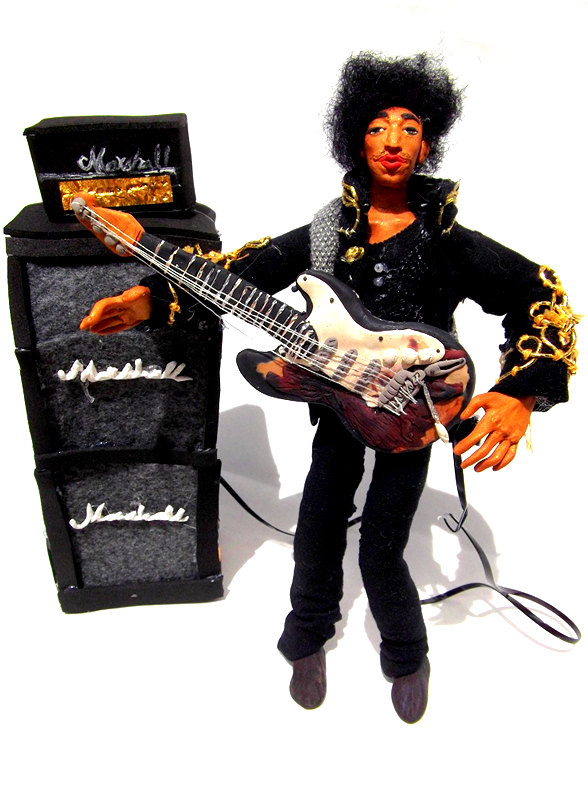
When Dr. John Bannister pronounced Jimi Hendrix dead on September 18, 1970 the story of this iconic musician should have come to graceful ended with his legacy being the foundation for old and new fans alike, although unlike his predecessors Hendrix was already subject to the unscrupulous dealings of the dark side of the music business. By 1967, as Hendrix was gaining in popularity, many of his pre-Experience recordings were marketed to an unsuspecting public as Jimi Hendrix albums, sometimes with misleading later images of Hendrix. The recordings, which came under the control of producer Ed Chalpin, with whom Hendrix had signed a recording contract in 1965, were often re-mixed between their repeated reissues, and licensed to record companies. Hendrix publicly denounced the releases, describing them as “malicious” and “greatly inferior.” These unauthorized releases have long constituted a substantial part of Hendrix’s recording catalogue, amounting to hundreds of albums.  In 1993, MCA Records delayed a multi-million dollar sale of Hendrix’s publishing copyrights because Hendrix’s father Al Hendrix was unhappy about the arrangement. Under a settlement reached in July 1995, Al Hendrix prevailed in his legal battle and regained control of his son’s song and image rights. He subsequently licensed the recordings to MCA through the family-run company Experience Hendrix LLC, formed in 1995. In August 2009, Experience Hendrix announced that it had entered a new licensing agreement with Sony Music Entertainment’s Legacy Recordings division which would take effect in 2010. Legacy and Experience Hendrix launched the 2010 Jimi Hendrix Catalog Project, starting with the release of Valleys of Neptune in March of that year.  

In the months before his death, Hendrix recorded demos for a concept album tentatively titled Black Gold, which are now in the possession of Experience Hendrix LLC. The demo tapes consist of 16 songs, all created by a solo Hendrix armed only with his voice and a Martin acoustic guitar. Months later, at the Isle of Wight Festival, Hendrix gave the tapes to his drummer Mitch Mitchell to have him listen and comment on the necessary rhythm section requirements for recording the songs. After Hendrix’s death in September 1970, Mitchell simply forgot about the tapes, apparently unaware that they were one-of-a-kind masters. For 22 years, the Black Gold tapes sat in a black Ampex tape box that Hendrix tied shut with a headband and labelled “BG”. It was not until 1992 that Tony Brown, the avid Hendrix collector and biographer, interviewed Mitchell and learnt that the mythical Black Gold tapes, thought to have been stolen from Jimi’s apartment by vandals who ransacked it for collectibles soon after his death, were lying in Mitchell’s home in England. Mitchell also possessed the Martin guitar that was used to create the material. Brown was invited to review the tapes and published a summary of his account, but to date the material has not been released and is not available to Hendrix collectors. Mitch Mitchell’s association with Experience Hendrix LLC was an indicator that Black Gold might see worldwide release. Mitchell’s death, however, means that the future and whereabouts of Black Gold are even more uncertain. In March 2010, Janie Hendrix stated that Black Gold will be released this decade. “Suddenly November Morning” was included in the album West Coast Seattle Boy: The Jimi Hendrix Anthology, released in November 2010.  This is the only track from Black Gold ever released.

Jim Morrison Infant Snapsuit

Jim Morrison Infant Snapsuit

An American Prayer is the ninth and final studio album by the Doors. In 1978, seven years after lead singer Jim Morrison died and five years after the remaining members of the band broke up, Ray Manzarek, Robby Krieger, and John Densmore reunited and recorded backing tracks over Morrison’s poetry (originally recorded in 1969 and 1970). The album received mixed reviews and still divides critics, yet it has managed a platinum certification in the US. When the album was originally released, longtime Doors’ producer Paul Rothchild labeled the album the “rape of Jim Morrison.” Morrison himself, prior to leaving for his ill-fated Paris visit, had approached composer Lalo Schifrin as a possible contributor for the music tracks meant to accompany the poetry, with no participation from any of the other Doors members. Since the demise of The Doors as a functioning band their back catalogue of albums has  been subjected to all forms of digital re-editing, special anniversary mixes, bonus material that inevitable consists of weak studio outtakes of classic tracks, as wells banal studio chitchat. The dreadful licensing of tracks to superstar DJ’s who in turn have managed single-handily to tear the heart of the material for a so called new generation of fans. Over 20 live official live albums have subsequently been released, including Live at the Aquarius Theatre: The First Performance and Live at the Aquarius Theatre: The Second Performance. In 2002 two of the original Doors, Ray Manzarek and Robby Krieger reunited and produced a new version of The Doors, called The Doors of the 21st Century. The lineup was fronted by Ian Astbury of The Cult.

John Densmore the bands original drummer subsequently claimed that he had not been invited to take part in the reunion. By February 2003, it was reported that Densmore filed an injunction against his former band mates, hoping to prevent them from using the name The Doors of the 21st Century. It was further reported that both Morrison’s family and that of Pamela Courson had joined Densmore in seeking to prevent Manzarek and Krieger from using The Doors’ name and in July 2005 Densmore and the Morrison estate won a permanent injunction. This caused the new band to switch to the name D21C. Densmore has been steadfast in refusing to license The Doors′ music for use in television commercials, including an offer of $15 million by Cadillac to lease the song “Break on Through (To the Other Side)”, feeling that that would be in violation of the spirit in which the music was created. Densmore wrote, “People lost their virginity to this music, got high for the first time to this music. I’ve had people say kids died in Vietnam listening to this music, other people say they know someone who didn’t commit suicide because of this music…. On stage, when we played these songs, they felt mysterious and magic. That’s not for rent.”  I guess it cannot be put any better.

Woebegone

sam-smith

Don’t worry son the bus will turn up soon

During a recent interview warbler Sam Smith explained the naming of his debut album (In the Lonely Hour) and he could not have not sounded more pitiful, “I wrote about being sad. Hopefully I’ll be happier soon and I’ll write about that.”  Colin Vearncombe who briefly enjoyed mainstream success under the moniker Black was equally despondent with his miserably infused 1987 hit single Wonderful Life, but unlike Smith, Vearncombe was making a not so subtle reflection of the times he found himself in where yuppies scoured the earth like apologetic zombies swigging champagne from Berluti handmade shoes. The Welsh band Racing Cars plunged the depths of misery in 1977 with their one and only hitThey Shot Horses Don’t They.’  The song, which is  based on the film of the same name concerns itself with a man who in his youth saw a horse break its leg, after which it was shot and put out of its misery. Arguably the accolade for most miserable song ever recorded would properly go to Buddy Holly for his 1959 effort ‘Raining in my Heart.’  The Beatles paraphrased ‘Raining in my Heart’ in their song ‘Dear Prudence’ as “The sun is up [instead of “out”]; the sky is blue.”  In 1978 self styled sad clown Leo Sayer had a hit with ‘Raining in my Heart’ and to cement the songs claim Robert Wyatt included a piano based instrumental version on his 2003 album, Cuckooland.

Recorded in 1990 and initially hidden away on the box set Tracks (1998) the Bruce Springsteen song ‘Sad Eyes’ takes some beating. The song was produced at a time when Springsteen was apparently re-evaluating his life. Enrique Iglesias covered ‘Sad Eyes’ in 2000. Sadly, Inglesias’ video for the track failed to capture Springsteen’s original intent. The video was shelved due to its sexual content. It depicts Iglesias alone in a motel room indulging in erotic fantasies about a girl he sees in a phone-sex ad. If you have just ended a relationship and you are surrounded in downcast misery I suggest you avoid at any cost Dusty Springfield’s version of “I Just Don’t know what to do with myself.”  First recorded by Tommy Hunt in 1962 Springfield recorded her version two years later with heart shattering effect Springfield delivered misery that has not often been matched, “I just don’t know what to do with my time, I’m so lonesome for you it’s a crime, going to a movie only makes me sad, parties make me feel as bad. When I’m not with you I just don’t know what to do.” The song reached number 3 in the summer of 1964 and remained Springfield’s highest charting UK hit until she reached Number 1 in 1966 with “You Don’t Have to Say You Love Me.”  

clown_468x582The point being made is the maze of love, hate, loss and fear we humans are required to navigate has and will always continue to provide creative output. It is the story of our fragile existence. It has been played out in classical operas, Shakespearean plays, sugar coated pop hits, movies and novels. Leonard Cohen and Nick Cave have cultivated misery into an art form, but unlike the phoney sadness often portrayed in today’s onslaught of manufactured pop stars Cohen and Cave have dragged the essence of misery from the bowels of their human frailty into carefully crafted stories and songs.  This is in contrast to the pity seeking artist feeding an equally self pitying audience, which we can increasingly witness today via disposable pop stars. The result is an overflowing eco-system of self flagellation between artist and audience, although there is of course benefits to an artist being in this predicament given they expect nothing good to happen in their miserable lives they will never feel disappointed or disillusioned by criticism.  It is not the art of creating a carefully crafted song of heartache that should be of worry, but the sheer quantity of banal misery based entertainment currently being manufactured and pumped out to an absorbing audience that should be of concern.  At the point of writing this blog of the top 25 chart singles 15 of the songs listed concern themselves with failed relationships, heartache and lost love with titles such as ‘me and my broken heart, love runs out and only love can hurt like this’.  

Fear in particular is a powerful and primitive human emotion. It alerts us to the presence of danger and was critical in keeping our ancestors alive. Fear can actually be divided into two stages, biochemical response and emotional response. The biochemical response is universal and the emotional response is highly individualised.  Whilst the majority of people will avoid situations in which there is a high risk of actual injury the experience of being scared in an environment that is actually safe has enabled an entire industry to be built. Horror films and violent video games are examples of this phenomenon, but repeated exposure to similar situations leads to familiarity. In turn this greatly reduces the resulting elation, leading people to seek out new and bigger responses to satisfy their needs. Sound familiar? Well, if you reflect upon the entertainment business over the past 30 years it tells its own story.

By the 1970s the tone towards more realism in motion pictures started to produce some harrowing films. Solider Blue was the third most popular movie at the British box office in 1971. Directed by Ralph Nelson and inspired by events of the 1864Sand Creek massacre in the Colorado Territory,USA. Released during the Vietnam War, shortly after public disclosure of the My Lai massacre, the film was controversial at the time not only for its subject matter, but also for its graphic depictions of violence. Nelson pushed the depiction of violence to explicit levels, showing nudity during rape scenes, as well as realistic close-up shots of bullets ripping into flesh. By 1992 Quieten Tarantino was shocking cinema goers with his debut film Reservoir Dog. The film received substantial criticism for its strong violence and language. One scene that viewers found particularly unnerving was the ear-cutting scene. It was reported that the actor Michael Madsen, who carried out the scene reportedly had great difficulty finishing it, especially after Kirk Baltz (playing the victim) ad-libbed the desperate plea “I’ve got a little kid at home.”  Meanwhile It took several complaints before a poster campaign advertising the film The Last Exorcism, which featured an image of a girl in a blood-soaked dress to be removed because it was deemed unsuitable to be seen by children. The adverts were posted on bus stops and on the sides of buses. Optimum Releasing, which ran the ads, said that the campaign was designed to target a broad, mass-market audience and intended to position the movie as a mainstream horror release with imagery “within the fictional context of this genre”. Once it learned of the complaints the company instructed its media buying agency to remove any ads displayed near schools. Last  year was a bumper year for horror films with the release of sequels, remakes and original materials with such titles as Dead before Dawn, Nothing Left to Fear, I Spit on your Grave 2, No One Lives, You’re Next, Evil Dead, etc.

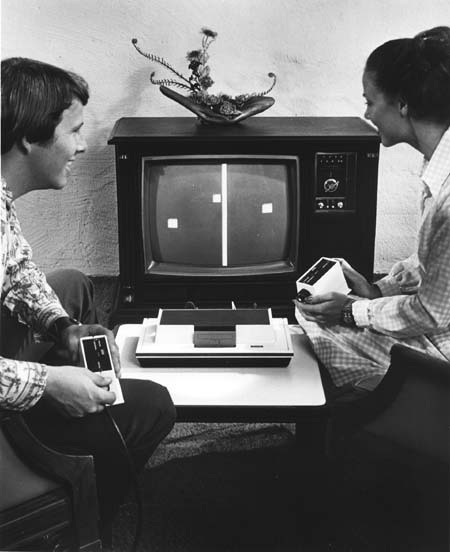
Atari set the whole videogame craze in motion with its 1972 coin-operated arcade game Pong. During the arcade years that followed, Atari made several coin-operated hits: Breakout, Atari Football, Asteroids, Battlezone, Missile Command, Centipede, Dig Dug, Pole Position, Marble Madness, Gauntlet, and even a Star Wars arcade game. While the graphics seem rudimentary by today’s near photo-realistic 3D gaming standards, when consoles were first released in the late 1970s it was revolutionary to be able to interact with your TV set in such a way. The simple aim of the game Pong is to defeat an opponent in a simulated table-tennis game by earning a higher score. Allan Alcorn created Ponga as a training exercise assigned to him by Atari co-founder Nolan Bushnell. Bushnell based the idea on an electronic ping-pong game included in the Magnavox Odyssey, which later resulted in a lawsuit against Atari. Surprised by the quality of Alcorn’s work, Bushnell decided to manufacture the game. Pong quickly became a success and is recognised as the the first commercially successful arcade video game machine, which helped to establish the video game industry along with the first home console. The violence in the 1997 Carmegeddon video game comes from the sheer ability to run people down in the most imaginatively brutal ways possible with a multi-purposed road hog reminiscent of those seen in the 1975 film Death Race 2000.  What separated 2000s Soldier of Fortune from the others in the field of violent video games was the use of the GHOUL System, a physics-based game engine that enables the player, for a lack of a better term,torture and brutalise enemies at your most sadistic desires. By 2001 the video game Grand Theft Auto 3 was offering gamers the opportunity to be entertained by barbecuing prostitutes with flamethrowers. The top selling video games last year included Grand Theft Auto V, Assassin’s Creed V and the Last of Us.  

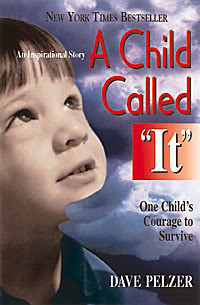
‘A Child Called It’ was published in 1995. Written by Dave Pelzer it is a brutal book concerning his childhood of being beaten and starved by his emotionally unstable, alcoholic mother. As one review highlighted, “Dave’s bed was an old army cot in the basement, and his clothes were torn and raunchy. When his mother allowed him the luxury of food, it was nothing more than spoiled scraps that even the dogs refused to eat.”  Dave went on to pen:

  • The Lost Boy: A Foster Child’s Search for the Love of a Family,
  • A Man Named Dave: A Story of Triumph and Forgiveness,
  • Help Yourself: The Privilege of Youth, Help Yourself for Teens.

By 2009 Dave seemed to have addressed his demons in his book, Moving Forward.  Richard Pelzer (Dave’s brother) shared his demons with ‘A Brother’s Journey’ detailing his experiences of witnessing and participating in the abuse of his older brother. He also penned A Teenager’s Journey. Both Dave and Richard are available for hire as motivational speakers. The tortures of human existence expressed through the medium of book shows little sign of slowing down with anybody who has managed to garnish 15 minutes of fame and willing to share their unique sadness. The top selling 2013 book on the Amazon website were The Fast Diet. Whilst real life “tragedy” biographies were dominated by the author Cathy Glass and her offerings,

  • Cut: The true story of an abandoned, abused little girl who was desperate to be part of a family. 
  • Damaged: The Heartbreaking True Story of a Forgotten Child and
  • Another Forgotten Child. 

Whilst an epidemic of similar books sold in their millions including cheerful titles like,

  • No One Wants You: A true story of a child forced into prostitution.
  • Shattered Lives: Children Who Live with Courage and Dignity.
  • Nobody Came: The appalling true story of brothers cruelly abused in a Jersey care home
  • Handstands In The Dark: A True Story of Growing Up and Survival. 

On the opposite shelving from the ‘truth life stories’ the would be customer can also find an array of ‘self help books’ too. Should we even be bothered about the entertainment industry funding and commissioning such a high supply of  doom ladened, miserable, violent, emotionally heartbreaking material? After all would it be to sinister to suggest the entertainment industry is seeking to manipulate your emotions……….

Facebook, the world’s biggest social networking site faced a storm of protest after it revealed it had discovered how to make its users feel happier or sadder with a few computer key strokes.  In effect what Facebook did secretly, involved a study involving 689,000 users in which friends’ postings were moved to influence moods. Facebook were caught redhanded conducting a mass experiment in emotional manipulation. If government had been caught in the same way the outcry would properly have caused far more angry reaction. If manipulating our emotions is as simple as changing a few postings on our Facebook page what impact is the collective onslaught of misery based entertainment having on the populous in general? The key worry about the Facebook story is just how quickly it disappeared from the headlines and our subconscious.  When did we become comfortable and accepting of big business holding so much personal information, which we have given up voluntarily and then enables them to utilise this information to manipulate our emotions?

Culture is of course the manifestation of what we do, think and feel. It is vital because it enables us  to function with one another. Our culture is a way of life. It concerns itself with our behaviours, attitudes, beliefs, values, and symbols that we accept, generally without thinking about them, and this culture is passed along by communication and imitation from one generation to the next. Whilst violent force may win wars those who can influence a culture are more likely to have a bigger and more sustainable impact.  Manipulating culture for a defined end, or to secure an interest is nothing new. Hermann Wilhelm Göring was a German politician, military leader, and leading member of the Nazi Party. He founded the Gestapo in 1933, and later gave command of it to Heinrich Himmler who was the psychopath behind the final solution. In 1941 Adolf Hitler designated Göring as his successor and deputy in all his offices. So altogether not a vey nice guy. Goring made the following observation, “Naturally, the common people don’t want war; neither in Russia nor in England nor in America nor, for that matter, in Germany. That is understood. But, after all, it is the leaders of the country who determine the policy and it is always a simple matter to drag the people along, whether it is a democracy or a fascist dictatorship or a Parliament or a Communist dictatorship. Voice or no voice, the people can always be brought to the bidding of the leaders. That is easy. All you have to do is tell them they are being attacked and denounce the pacifists for lack of patriotism and exposing the country to danger. It works the same way in any country.”  

The sheer quantity of misery induced products being consumed may represent a race to the bottom of the entertainment barrel, whilst its creative producers are desperately mining  our sensitivities trying to discover new ways of stimulating our increasing fatigue. Certain trends in society, which run alongside the increased level of misery induced products being consumed are interesting to read:

  • Research in the USA provided data indicate that the percentage of people treated for depression tripled in the early 1990s with a more modest increase in the early 2000 era. About 75% of the patients who were treated for depression received antidepressant medications. (Eugene Rubin MD, PhD and Charles Zorumski MD, Phycology Today)
  • The number of young people aged 15-16 with depression nearly doubled between the 1980s and the 2000s. (Office for National Statistics (1997): Psychiatric morbidity among young offenders in England and Wales).
  • The proportion of young people aged 15-16 with a conduct disorder more than doubled between 1974 and 1999, (Nuffield Foundation 2013 Social trends and mental health).
  • 39,518 suicides were reported in the US in 2011, making suicide the 10th leading cause of death for Americans.
  • Suicide is a significant national social issue in the UK; 6,045, 5,608 and 5,675 people aged 15 and over committed suicide in 2011, 2010 and 2009 respectively.The number of male suicides in 2011 was the highest since 2002.

There is of course no scientific evidence linking the onslaught of misery produced entertainment with the statistics set out above. Our ignorance will be our ultimate downfall.

Today I Stumbled Upon: Ghost to Falco

Ghost to Falco_behind_tumbleweedI find myself walking alongside the River Thames. It’s a walk I take most Thursday evenings whilst making my way to Waterloo Station for the long train journey home. It is a pleasant evening as I occasionally glance over to the House of Commons,  Big Ben, wearing my headphones and navigating the tourists, whilst flipping through the Bandcamp app on my iPhone. I’ve just pressed play. The Soft Shield album by Ghost to Falco kicks in with openner Enemies Calling and I instinctively stop, take a public seat and listen to the whole album whilst viewing the river and the features on the opposite riverbank. Finally finding my way home I purchased the album and email the brain child behind Ghost to Falco, Eric Crespo who lives in  Portland, Oregon, USA.  This blog mainly consists of email exchanges between Eric and myself, as well as the virtual digging I have managed to undertake. Portland of course has one of the most vibrant music scenes in the USA. My earliest recollection of a band from Portland was The Kingsmen, who had the hit Louie, Louie in the early 1960s. It’s a little know fact that In February 1964, an outraged parent wrote to Robert Kennedy, then the Attorney General of the United States, alleging that the lyrics of Louie Louie were obscene. The FBI investigated the complaint and, after four months of investigation, concluded that the recording could not be interpreted because it was “unintelligible at any speed”.

Eric Crespo was born in Los Angeles, California where he lived until eight years. at this ripe age his parents moved the family to Burlington a small town in North Carolina. Burlington is situated 40 minute drive from Chapel Hill, which would prove to be a critical influence to Eric given its underground rock music scene. Eric recalls Chapel Hill has a college town.  “In the time (mid 90’s) there was a quite a scene there.  The most noteworthy bands from Chapel Hill that were active when I started going to shows were Superchunk, Polvo, and Archers of Loaf.  Polvo was my favorite out of those three but I’d go see all of them, and they’d usually have some other interesting bands on the bill with them.  And all the touring bands would come through.  While I was a teenager I 10264709_10152161629904302_3003215836447863725_nsaw bands like Dirty Three, Mogwai, Guv’ner, Modest Mouse, Shudder to Think, Fugazi, June of 44, Pavement, Storm and Stress, Sebadoh, Blonde Redhead, US Maple, Elliot Smith, Unwound, and many more all playing at various small clubs–sometimes to about 10 people.  I saw Sonic Youth play secret shows in Chapel Hill on two different occasions at a smallish club (probably 650 capacity?) called The Cat’s Cradle.  I even saw Radiohead once at the Cat’s Cradle right after the Bends came out.  I wasn’t really a fan (and I’m still not) but I’d just go to shows..”  Eric then moved to Asheville, NC to go to college.  In his sophomore year he found himself living with friends and rightfully having fun. “I knew I had to leave though.  I felt like I was just waiting for something important to begin. I played in two bands that toured around the region a bit.  We’d go play in Atlanta or DC, but my bandmates in those bands weren’t really up for touring like I was.  Touring was all I really wanted to do at the time, so I was trying to come up with ways to play out alone just so I could tour as much as I wanted.  I may have never started Ghost to Falco if the people in my bands really wanted to tour like I did.”

10371438_10152270693314302_1731744634009158020_nSo how did the solo work start to evolve? “When I first started thinking of playing out solo my first idea was to go the acoustic guitar/singer-songwriter route.  I had a nylon string classical acoustic guitar, but I felt like I needed a steel string acoustic for some reason, and oddly enough I actually ended up finding one on the street one day.  In the middle of a crosswalk in downtown Asheville.  It seemed like it had fallen out of a car or something.  So I started trying to write songs on that but it wasn’t happening.  I had no frame of reference really for being a singer-songwriter.  I had no interest or knowledge of folk singers or anything like that.  I kind of put the acoustic away after a few months (or weeks—I can’t remember).  A little later I started messing around on my electric guitar with a looping pedal and I put my newly acquired monophonic 70’s analog synthesizer into the mix and I started making up these loose song structures that sounded pretty full even though I was the only one making the sounds, and that excited me. I thought maybe I could play shows like that but wasn’t sure. Around this time I was also getting interested in a lot more stuff that was outside of what I had grown up listening to.  Minimalist composers (Steve Reich, etc.), late 70’s industrial music, Glenn Branca, and “freer” bands of the era. Another thing about starting Ghost to Falco is that I had played in bands since I was fourteen years old.  I didn’t know how not to be in a band.  It was, and still is the way I find friends, my motivation to travel, my motivation to do anything really.  So, starting a band that could never break up unless I wanted it to was pretty appealing.  I left North Carolina in October of 2001.  My bands played our final shows, I got my wisdom teeth taken out, and then hit the road to Portland.” 

The Ghost Falco moniker began in 2001 as a solo project consisting of electric guitar loops, synthesiser sounds and field recordings. The band has gone on to became something of an underground institution with a rotating door of musicians have joined for tours and recordings bringing with them a whole range of instruments. “The first Ghost to Falco show I ever played was in Athens, GA (a place I have never lived) on the way to Portland, followed by shows in Shreveport, Louisiana, Lubbock, Texas, and a kid’s garage in a suburb of Los Angeles.  These shows were painstakingly booked by sending out a cassette of a song I sneakily recorded in the studio of my college on an exam day of my last semester.  I didn’t really know how I would feel about doing Ghost to Falco live, but it turned out that I generally felt pretty good about it so I decided to keep doing it.  I always thought I might add some band members to the mix at some point down the line and I did that in 2005 and live shows have gone back and forth between being me solo and having bandmates.  Nowadays I prefer to have bandmates in the band.”

So what are the challenges facing an artist like yourself? “Probably the biggest challenge in getting my music out there is the music I’m making!  It’s sort of always existed between worlds.  I designed it like that initially.  I liked avant-garde music and I liked good songs with singing.  I sort of wanted to do something to unite these two worlds, and in doing so I didn’t really create a new scene, but I just sort of made Ghost to Falco this free floating entity.  When you’re doing something different and it doesn’t adhere to the tenets of an established scene, or have enough people involved to create a new scene you just end up existing as a free floating anomaly.  People might agree that it’s good but people want to align themselves with things that make them a member of a tribe or a community.  People want connection.  Most of the time it takes some kind of noted tastemaker (preferably with lots of money) to step up and champion it before even a decent amount of people will take notice.  We’ve had a few minor taste makers sing our praises over the years, and that’s why today we can boast that we have 980 Facebook likes”  
Then there’s the whole music establishment?  “Let me just go off on this for a minute, because I’ve been meaning to write this down for a little while.  Within the realm of the kind of music we’re making, this is my perception of how things generally work (of course there are  exceptions):  It’s a 1978818_10152266495739302_3771852591971329847_n big whirlpool where everybody is paying each other.  The noteworthy record labels, (not even talking major labels unless you count Merge, Sub Pop, and Matador as majors, which I guess are majors at this point) are probably like the sun that all the other planets of the industry revolve around.  So these labels pay the PR firms.  The labels buy advertising on Pitchfork and other popular blogs and music magazines.  These popular blogs and music magazines are obligated to write about bands that are being pitched by PR firms who are hired by the record labels, who buy advertising on these blogs and in these music magazines, which pays the salaries of the people who run the blog or music magazine. When these bands get written about by the popular blogs and magazines then the booking agencies start calling and then these bands get a booking agent.  The booking agent book the bands on high profile tours and festivals and the bands get popular.  This system doesn’t work if the popular blogs and such write about anything that any nobody band sends them.  Then no one gets paid.   And the booking agents aren’t going to want to book a band with no hype behind them.  You can’t blame people really.   There’s only room for so many bands and writers and promotional agents and such in this world.  And there’s even less room for people who are making risky music.  To make a food analogy: Even a big city can only support a certain amount of high end vegan restaurants, while the pizza places on every other corner are turning a fine profit.  People like pizza and it’s fast and it’s cheap and it fills you up.   There’s nothing wrong with pizza.  I like pizza.   The music I tend to make requires a little more patience and a little more time, maybe it’s a little harder to find the entrance to the place, but I hope that in the end it’s going to be more nutritious.”  
 Back to the whirlpool, “there are bands that get thrown into it and don’t connect with people that happens all the time, and then they just fade away.  And some are on the edges of the whirlpool and some are right in the middle of it.  Ghost to Falco has never been in this whirlpool at all and never really had the chance to connect with a lot of people in this way. No one at a popular label (or management company who gets you on the popular label) has had enough of an interest to take Ghost to Falco on.  I wonder how we would do if we were to get thrown into that whirlpool.   We might do fine, but who knows?   It’d be nice to be able to connect with a lot more people, but it’s sort of cool running the band how we do.  We only tour when we want to and we can play whatever kind of venue and play with whatever bands we want to play with.  No one is shaping our career.  It is a freedom I appreciate.  We don’t really make money, but it’s never a situation of the label is making us tour, this sucks, kind of thing.  I’ve had friends in those situations and it seems terrible.”  

Soft Shield is Ghost to Falco’s fourth full length album. The albums initial sessions began at the Portland-based Type Foundry Studio (known for producing recorded output by the likes of  Dirty Projectors and R.E.M. among many others) in June of 2009. A few days after the first sessions Eric left town for six months of touring and traveling. When he came back with his limited funds, Eric realised that going into debt on an album at a top-of-the-line recording studio maybe wasn’t the smartest thing to do. But it was too late.  He earned money from odd jobs and spent it on studio time, and/or relied on generous favours from recording engineers. It took three-and-a-half years to finish Soft Shield. Eight different studios were used in all. The album is properly the most cohesive of any record in Ghost to Falco’s discography.

Soft Shield still casts a wide net that marks most of Ghost to Falco’s output, one could find evidence of just about every rock- affiliated musical movement of the past fifty years, but Soft Shield corrals those disparate elements into a vision that feels firmly planted in the American-West. Trippy desert guitar lines and arid pedal steel are intertwined with a lush and intimate, Northwest-specific, Twin Peaks style of mystery— a duality that points to both Eric’s love of the American desert canyon country and his longtime Portland address.  As Eric says, “There’s contentment, anger, humor, regret, fear—and hell, some of it you can even dance to” and I could not put it better myself.

During my virtual journey of discovering Eric and the Ghost to Falco’s back catalogue I came across another of Eric’s projects Centers, which was formed by Jay Demko and Eric Crespo in mid 2010.  Whilst I absolutely adore the Ghost to Falco catalogue and have no hesitation in recommending them the Centers album is also a piece of magnificent beauty and worthy of any serious music collection. 

Eric Crespo is a musical chameleon who weaves genres together and pushes creative boundaries, avant-garde sound structures, alt-country, world fusion with carefully crafted lyrics all blended together. He is the is type of artists we should increasingly celebrate given the quality of his work and the creative space he occupies often results in very few finding full commercial success. His craftsmanship finds itself at odds with the conveyer-belt of mass consumed music that is often found seeping through many a MP3 player.  Neil Young is credited with saying, “When people start asking you to do the same thing over and over again, that’s when you know you’re way too close to something that you don’t want to be near.”  It’s an interesting observation from an artists who is respected and who has influenced many. Neil Young of course had the means to take a left-field turn from middle of the road comfort before he cranked up his amplifier. In reality the true creative forces on this highway are artists like Eric Crespo, who did not take the middle of the road in the first place.

Today I Stumbled Upon: Cloud Ensemble

enoRenowned and often credited with being the inventor of modern ambient music, which many try to emulate. A genius he maybe, but Brian Eno certainly as a lot to answer for in my view.  Bandcamp is cluttered with lonely souls who are cramped up in desolate bedrooms with their laptops striving to create something interesting from overlaid, looped and distorted droned tones that are absent of traditional musical structures.  

Personally I’ve always been a little susceptible to the odd Eno album and must admit to having a few in my collection, but it is the type of music I purchase very sparingly.

Advancement in technology has created access for most people regardless of capabilities to produce something that would have sounded groundbreaking back in the 70s and 80s. This is healthy and to be encouraged, but this is also one of my criticism of this music genre.  We end up with a vast field of producers creating an abundance of medico material. I need to be brutally honest. Once you have heard one stretched out and droned note that has been processed to death on a computer, well it can be a down hill experience afterwards because the next offering is properly going to sound very much the same. Don’t get me wrong  whilst I consider albums like Apex Twin’s ‘Selected Ambient Works Volume 2’ a certified classic. Many artists, including Radiohead, Lou Reed, U2 and Nick Cave have all dabbled in this genre with the results (in my view)  being varied to say the least.  1995s Passengers  (U2, Eno plus guests) Album ‘Original Soundtracks No 1’ was so pretentious that even U2’s Larry Mullen quite rightly observed, “There’s a thin line between interesting music and self-indulgence. We crossed it on the Passengers record.” The only saving grace for the album was the ‘Miss Sarajevo’ track , which featured the late Italian tenor Luciano Pavarotti on vocals.

It is when ambient music is not solely dependent upon the one trick pony of synthesised drones that the genre starts to come alive and provoke something interesting for me.  Eno himself defines ambient music as, “evoking an atmospheric, visual, unobtrusive quality” and personally for me only a handful of albums over the past 15 years have stood out by using Eno’s template. Here is a selection from my collection:


The soundtrack from the film ‘Monster’s Ball’. The scores by Asche and Spencer are just spine chilling and fragility personified.  The Boards of Canada ‘Geogaddi’ is a mesmerising  kaleidoscope of sounds. Mum, ‘Finally we are no one’ is a beautiful and fragile landscape. I saw Lampchop perform ‘Nixon’ live at the Royal Albert Hall, London. I have never seen so many people on one stage create so little noise. Sigur Ros, ‘Med Sud i Eyrum’ album was for me their coming of age. The Laurie Anderson album ‘Life of a String’ is just beautifully haunting.

Cloud Ensemble 

I have recently added a further release to this list. The EP ‘Cloud Ensemble’ by Cloud Ensemble, which consists of 3 tracks and is the product of a file sharing project between:

Michel Banabila : ebow, guitar, logic pro, field recordings 
Grzegorz Bojanek : field recordings 
Oene van Geel : viola, stroh violin 
Radboud Mens : glass sounds, dopplo, treatments 
Yuko Parris : voice, squeaky sounds, electric piano 
Rutger Zuydervelt : philicorda organ

Here and There is a 10 minute soundscape that captures a mixture of delicate voices flowing over almost orchestrated instruments and field recordings. Perfectly blended with the voice samples the track is an absolutely sublime Friday evening wind down track, especially with headphones. Hide and Seek takes a different direction with whispered vocals the track builds and encompasses disjointed beat structures. Silent World the final track on the EP returns to the soundscape mode, but minus vocals.

I recently caught up with Michel Banabila from Cloud Ensemble and asked him the three Old Man questions:

JK: What was the main influences behind the album?

MB: Simply to collaborate. Everybody immediatly said yes. We like each others music of course. So I think there is an influence from everybody of the ensemble in the end result.

JK: Which is your favourite track and why?

MB: That might be for different for each of us. I like all three tracks. These three tracks are all a bit different from each other.

JK: If you could have a guest artist to appear on your next venture who would it be (dead or alive) and why?

MB: We are now working on the next recordings. I really hope we will do another album. So my favourite guest in future projects would simply be everybody from the Cloud Ensemble 🙂

The EP ventures into wide-eyed fairy-tale qualities at times by delivering simple melodic bliss to the listener. It will certainly not be for everybody, especially if your ear requires conventional song and rhythm structures, or crushing guitar solos. It is the conglomerate of instruments on the EP that initially gain attention, but ultimately the tender vocals on track 1 & 2 that add breadth to this beautiful journey.

There is 150 limited edition 1o” vinyl/hand numbered copies of the EP up for grabs via Bandcamp @ £6.40 (€8) plus postage, which also comes with an immediate download. A digital copy of the EP comes in @ £4.05 (€5). Enjoy.

IMG_2007

Issue No. 5

Oh bondage up yours!

This girl is no fool

This women is nobody’s fool

“Biblically chauvinistic” is how the Rolling Stone magazine described the James Brown 1966 record “It’s a Man’s Man’s Man’s World.” As a record it certainly takes some beating when promoting a stereotype. A stereotype, which has been continuously reinforced throughout the music business since its conception.

Whilst the mainstream charts may be dominated by female artists research constantly reveals that women working in the music business earn far less than their male counterparts – a staggering 47% of women in the music business earn less then £10,000 per year.

It is a business that is dominated by male executives who control its means of production, marketing and recording output. Recording artist Lily Allen recently observed, “You will also notice of the big successful female artists, there is always a ‘man behind the woman’ piece. If it’s Beyoncé, it’s Jay Z. If it’s Adele, it’s Paul Epworth. Me? It was Mark Ronson and the same with Amy Winehouse.”  These attitudes prevail throughout the music business right down to the basement end of manufactured pop. The banality of Miley Cyrus ‘tweaking’ caused a media stir, which was possibly related to Cyrus’s history as a child star for the Disney Corporation. Whilst Cyrus’s performance might be seen as silly and tedious the fact is Iggy Pop has been ‘twerking’ for 40 years, including the odd penis exposure as well as regularly humping his amplifiers on stage – yet he is considered a rock god.

There is something very disturbing about a popular culture that increasingly portrays women as disposable commodities frequently being hunted down by a serial killer or subjected to the creepy attention of a male artist who is acting like a potential candidate for inclusion on the sex offenders register. Although given the recent spate of celebrities facing sexual assault charges in the UK they may not be acting. Equally repugnant are those fellow men who shout “political correctness has gone mad” every time these issues are raised. Let’s be honest if you are the type of tool who enjoys women being portrayed in this way then it is highly unlikely you have read this far into this blog and you are properly jerking off to that misogynist Robin Thicke video.

“Ignore it” you may say after all there is an off button I can push  Well I did, but ignoring it does not make it a right. Switching off a TV does not mean switching off your brain and that is the real choice here. I am not for one minute advocating censorship far from it. In my view those who produce this material should be exposed to additional taxation. The revenues generated should be earmarked for support services for women who become victims of male violence. If a sovereign country was inflicting such harm on another country surely we would be expecting intervention, possibly economic sanctions.

Those women who have stood up, challenged and turned the tables on the status quo have faced ridicule or worse. The singer-songwriter, multi-instrumentalist, actress, author and philanthropist Dolly Parton has throughout her career been the subject of ridicule from taunts of trailer trash, cheap, dumb blonde and least we forget the breast obsession. Web sites are dedicated to crude jokes about Parton.  Realising these circumstances Dolly Parton played the card of self-parody as well as deploying her very clever business brain. This has enabled her to amass a financial fortune and make music that she wants to make.  This attitude towards women is not a modern phenomenon, which has  been cooked up by dead beat rappers with their pathetic lyrics of ‘hoes and bitches.’

holiday

Billie Holliday – used and abused

The harrowing demise of Billie Holliday in the 1950s is a prime example. Most media stories concerning Holliday’s torturous death tend to focus on sexual violence and illicit substances. What is often overlooked is that in her final years Holliday was swindled out of her earnings and died with $0.70 in the bank.  As an incredibly gifted, yet troubled artist Holliday was hounded to the very end. Whilst dying police raided her hospital room and placed her under arrest until she passed away on 17th July 1959. She was 44 years old.

The magnificent Nina Simone became the catalyst for change in the 1960s. Strong, intelligent, outspoken and a versatile musician she became a role model for musicians (female and male). Simone started playing the piano at 3 years old and by the age of 10, she was perfuming piano recital in the town library. Like Holliday, she was ripped off by the record companies. She saw very little money from her first record, the top 20 hit of “I Love You Porgy.” Simone always characterised record companies as “pirates.”   

Over the coming decades, Simone took increased control over her career and destiny as an artist, which not only provided financial rewards but enabled increased creative freedom. At the time this was unparalleled for both a female and Black artist.  The song Mississippi Goddamn, which she released in 1964 was written by Simone after the murder of Medgar Evers. Although the song contains a jolly rhythm it is a scathing anti-racist tour de force.  Towards the end of her life Simone became increasingly erratic with legendary mood swings. In 1985 she fired a gun at a record executive whom she considered was stealing her royalties claiming that she tried to kill him, “but missed.”

The 1960s produced many iconic female artists Dusty Springfield, Nico (Velvet Underground) Grace Slick (Jefferson Airplane) and Janis Joplin for example. It is a decade that increasingly witnessed the use of  ‘tabloid sensationalism’ as a weapon against women. Singer, songwriter and actress Marion Faithfull were subjected to sordid and untrue media reports in 1967 concerning her sexual relationship with Mick Jagger. Whilst the headlines and speculation did little to hinder Jagger’s career. In fact, the stories further enhanced his bad-boy reputation, but for Faithfull, her career was badly damaged. 27 years later Faithfull observed, “It destroyed me, a  woman in that situation becomes a slut.” Before Beyonce, there was Diana Ross (formerly of The Supremes).

The Supremes were a product of Barry Gordy’s Motown conveyor belt of popular hits during the 60s and 70s. Gordy was the original Simon Cowell with the gift of identifying and bringing together pop talent, along with tightly controlling and carefully managing their public image. Whilst Ross and Gordy were romantically entwined for Gordy it quickly became a case of biting off more than you could chew syndrome when it came to Diana Ross.

Whilst The Supremes were on a UK tour in the 1960s Gordy insisted The Supremes perform a version of Dean Martin’s “You’re Nobody Till Somebody Loves You.” Gordy believed that such a performance would enable The Supremes to access a slot on a mainstream UK television programme. Ross refused outright. “I could not explain anything that made sense to her,” Gordy said. “She refused to do it completely.” That’s when Gordy realised, “if she didn’t do it, I knew I could not manage them.” Ross went on to become one of the biggest selling female solo artists in music history.

Joni Mitchell produced and released her seminal Blue album in the early 70s whilst at the same time Jazz drummer Karen Carpenter was persuaded to move centre stage and sing for the brother/sister duo the Carpenters. It may have taken until 1979 for Suzi Quatro to score a hit in her country of birth (USA), but Quatro was a constant presence throughout the 70s in the UK charts. Quatro’s trademark leather jacket, jeans, bass playing leadership and pop-rock anthems presented an altogether edgier imagine that had a significant influence and impact. An influence that has sadly been underestimated given for many young people Suzi Quatro was the first female artists who were seen to be the leader of the pop-rock group on mainstream TV. By the mid-70s Kate Bush and Patti Smith emerged. Two diametrically opposed artist who commanded respect through their craft. Smith went on to release what many still consider to be one of the most quintessential and influential rock album’s of all time ‘Horses.’  

1975 also saw the release of the electro-pop ‘Love to Love You Baby’ by Donna Summer that pounded the dance floors of every credible disco. The song, which featured Summer moaning and groaning as if in the raptures of an organism would cause controversy around the world. It also presented the artist in a highly sexually charged way that would take Summer years to shake off. The song and its producers eventually left Summer feeling like she had no control over her life and went on to suffer from bouts of depression and insomnia. Summer would later become a born-again Christian and sue the producers of the record. After the legal settlement Summer decided to exclude “Love to Love You Baby” from her concert playlists and did not perform it until 25 years later.

As the 1970s were drawing to a close there was something quite different about the female artists who were emerging outside the mainstream. Whilst the recording output varied according to taste. The confidence and attitude of the female artists was not in dispute. Operating within an increasingly political environment a whole bunch of strong, independent, intelligent and often conformational female artists were playing a leading roll in the rock scene.  It was a time when Siouxsie Sioux (Siouxsie and the Banshees), Fay Fife (The Rezillos), Gaye Advert (The Adverts), Debbie Harry (Blondie), The Slits, Pauline Murray (Penetration),  Tina Weymouth,(Talking Heads), Joan Jett (The Runaways) and the glorious Poly Styrene (X-Ray Spex) to name a few took a male-dominated world and shook it by the throat. A quick search on Google for Penetration performing ‘Don’t Dictate’ live will emphasis the point as Pauline Murray tackles men in the audience head-on. It was another song from this period, which had a greater influence on me personally.

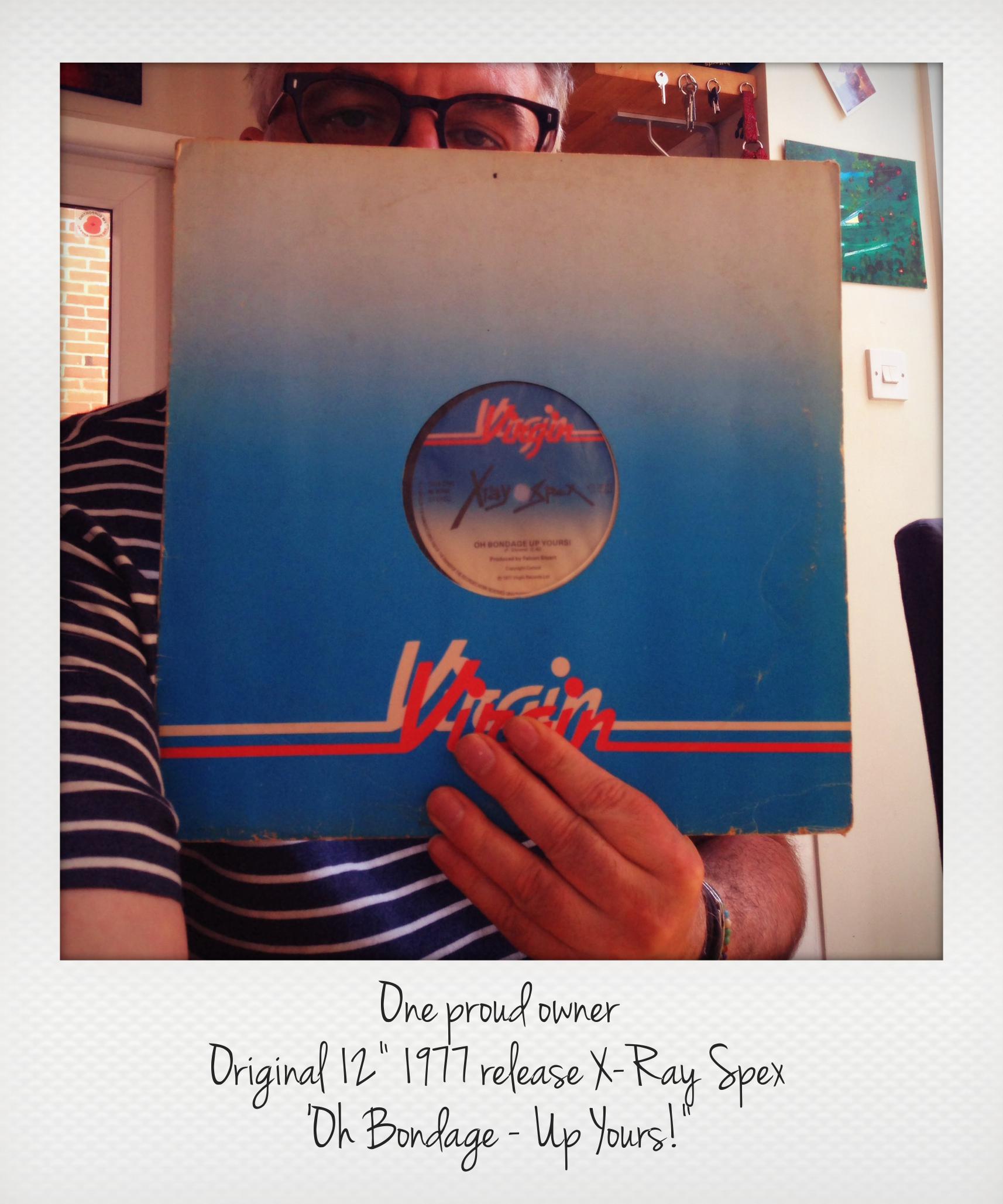
Released in 1977 “Oh bondage up yours” was the debut single by X-Ray Spex.  Polly Styrene was the bands’ lead singer and main songwriter who described the song, “as a call for liberation. It was saying: ‘Bondage—forget it! I’m not going to be bound by the laws of consumerism or bound by my own senses.’ It has that line in it: ‘Chain smoke, chain gang, I consume you all’: you are tied to these activities for someone else’s profit.” 

As I grow older and start to see the world more holistically I can often look back at key moments when a stake was placed in the shifting sands of my life. These stakes are important because they create a focus point when somethings clicked. When I get a cold chill after being exposed to yet another pile of misogynist crap by a retarded hunk in plastic bling rubbing his small codpiece against a scantily dressed women. I can point back to buying the original 12″ vinyl version of “Oh bondage up yours” in 1977.

Every cause has a counter effect and what had been achieved in the 1970s was to be challenged throughout the 1980s free for all and sod thy neighbour attitude. Samantha Fox’s was 16 years old when her mother submitted several photographs of her daughter in lingerie to a Sunday tabloid newspaper competition (Girl of the Year amateur modelling contest). By the 198os Samantha Fox was a popular topless glamour model in a daily tabloid. In 1986 Fox choose to take up a new career as a pop star. Her first release was the tacky ‘Touch Me (I Want Your Body)’ that reached No. 1 in seventeen different countries. She went on to sell more than 30 million albums and co-wrote the song “Dreams” for girl group All Saints’s 2000 album, Saints & Sinners. Although she was credited as “Karen Wilkin” because the group refused to record the song if Fox’s real name was used. In 1984 Sheena Eastern had a hit with a Prince written song ‘Sugar Walls’ a pseudonym for Eastern’s vagina.  By the close of the 80s Cher was to be seen cavorting around a battleship in a fishnet body stocking rattling out the hideous ‘If I could turn back time.’  Amongst this drivel there were occasional rays of sunshine from the likes of Chrissie Hynde (The Pretenders) and the Sugarcubes whose lead singer Bjork was to became one of the most original and innovative female recording artists of all time.

2778_Bjork_photo_1

Thank god for Bjork

As with most cases in life, it is not those at the vanguard who reap the rewards of their struggles. Kim Gordon (Sonic Youth), Courtney Love (Hole), PJ Harvey, Riot Grrrl, Sleater-Kinney, Grace Jones, Beth Ditto (Gossip), Poison Ivy Rorschach (The Cramps) and the stunning Skin (Skunk Anansie) were to find their journeys just that little bit more easier because of the women who had gone before. In turn, this made for a more creative and fertile music scene for the rest of us to enjoy. It would of be interesting to hear the views of these female artists regarding female artists in the mainstream pop world today. I can only guess that for many it will be a case of raised eyebrows and recognition that syrup manufactured girl pop groups will always have a place.

I struggle to envisage many will sign up to the ‘girl power’ of the Spice Girls call to arms, “I wanna, I wanna, I wanna, I wanna, I wanna really really really wanna zigazig ha.”  In truth, their struggle and achievements will seldom be recognised in the mainstream, because the mainstream needs to be controlled and manipulated from above. The advent of technologies has in many ways released the creative artist to pursue their particular path, but success on a scale that will enable economic independence remains a long way off for many female artists.  As a father of 3 daughters, it is with great relief that when foraging around Bandcamp I have discovered such an amazing range of female artists who are producing some truly magnificent material. To name a few:

xray


Today I Stumbled Upon: Mogo Kutu

0002289145_10It’s 8.30am on route to work in an overcrowded train from Clapham Junction to Waterloo Station London, headphones on, volume gentle, the train carriage swaying, the occasional cough from a passenger, frustrated telephone conversation, or the steel on steel wheels churning beneath my feet find a way into my private world. I’m standing and gazing around incidentally wondering about the lives of others. The sardine squeeze, people protecting their personal space, upholding their rights via the unwritten protocols of facial expressions. Obsessively we are all consuming the latest news, sports and A list gossip that is constantly streamed to our mobile devices. Smiles, sadness, hopes, regret and fears all canned up in a train moving slowly towards the City. It’s a pleasant day and the tensions of dark wintery mornings are starting to evaporate.

THIS BANDCAMP ACCOUNT NO LONGER EXISTS

Oblivious to everybody Mogo Kutu is singing in my ears and I feel good.

4217 miles away it’s about 2.30am in St. Louis, Missouri, USA. A place renowned for its blues and jazz Music. Chuck Berry, Miles Davis, Imrat Khan, Scot Joplin, Donny Hathaway, Fontella Bass, Grant Green, Tina Tuner (I forgive you for the 80s Tina) and the legendary Isley Brothers all have a connection back to St. Louis. Some happy and some not so happy connection, but regardless this creative rich list humbles any serious music fan and it is here where by accident I bump into Mogo Kutu.

So who is Mogo Kutu? As his aptly named blog One of Us is Lying (http://missouri-oneofusislying.blogspot.co.uk) states, “Mogo Kutu is just a name, It is me. It is something old, something new. One step forward, a lifetime back. To keep it simple. I make stuff. Sometimes I make music. Other times I capture images. Sometimes I write. I build up and I tear down. I regret and I laugh. I live and breathe. I want you to like this, to like what I create because I think it is good. I would not waste your time otherwise.” 

I managed to catch up with the man behind the Mogo Kutu project, Rob Woerther who has been a key figure in St. Louis contemporary songwriter scene for several years.  “I have kept and maintained a home studio and sang and played in a handful of bands through the 90s, recorded a few CDs and then got tired of packing up gear, playing in bars and smelling like smoke. Started recording local singer-songwriters as well as myself and put out 2 compilations of St. Louis singer-songwriters – Sweat Equity and Elbow Grease.”  After getting married, pursuing a career as a special education teacher, starting a family and finishing his doctorate Rob decided to give his academic career a well earned rest and start to take his songwriting and music more seriously. In December of 2013 he started to uploading his music to bandcamp.

At this point I will leave it to the storyteller, songwriter and singer to explain what is behind his collection of songs, which are now available on Bandcamp.

“Somewhere in middle America. The days are long. The creeks change with the season and at night you can still see just how small we are in this universe. When you are young all you can think of is leaving. Now I would give anything to go back.” 

G. Letters #1 started after I had found a box of letters my grandfather had written when he went off to fight in Germany during World War II. The letters, completely forgotten, had been found as we were cleaning out my Great grandmother’s house. Well into her 80s she saved a lot of our family’s history. From the family bible to these letters I slowly started to learn of my grandfather as a young man going through basic training.”  Ghost Waltz  was one of the first songs I had written on a banjo. It was also written at a time I was working through my grandfather’s letters from the war. This song is a bit different in that the characters drift away from my grandfather to a couple that was not as fortunate. The woman in the story is waiting for her husband to return only to be visited by his ghost. The war taking another victim as a wife mourns her loss. “God’s eyes came from reading a collection of short stories by Zora Neale Hurston. Ms. Hurston began collecting stories from the black southern communities in an effort to save them from being forgotten and lost. Her work helped act as a foundation for the Harlem Renaissance. While not directly an interpretation of a particular short story the song follows the loose narrative of a young man pushing his luck to see just how far he can go to prove himself.”

“As my dad has gotten older his love of baseball has become more of his persona. I appreciate him more because of it. Baseball is America’s story. In this day of modern toys and access to any information with a few clicks of a keyboard we still will huddle around a transistor radio and catch nine innings of the Cardinals versus the Cubs.  I come from a family of storytellers. Give us a good kitchen table, something to drink, and an unsuspecting audience and the laughter will echo through the house, out through the garage, and into the neighbor’s yard. It starts off innocent enough until some poor victim asks a question and then the yarns start to spin. I think I was always meant to be a songwriter because all those stories needed to go somewhere.” 

“Mud dreams came out of the past. I spent my youth surrounded by trees, creeks, and mud. The thrill of an empty day along a wide and angry river puts me at rest. Take a sip and watch your pole. Feel the breeze. Listen to the water.”

Lyrics that make you smile and reminisce about the fights, scrapes, first teenage kiss, growing pains, sunny days, family, friendship, love and the tensions of adult relationships. Mogo Kutu is pursuing the noble art of observing life’s little swerve balls and transforming them into carefully crafted songs. I genuinely find this work endearing. There is  lack of pretension and a sense of sincerity behind this artist who is writing and performing from the heart.  It is indeed the type of songwriting that is a product or age, growing maturity and experience.  I am thoroughly enjoying each release, which costs $1 (60p in the UK) for 3 tracks. Top quality music, a worthy addition to most collections, which comes highly recommended.

I walk into the office, sit down, take off my headphones, switch off the music, look around and smile. It’s a good day.

Kelvin Swaby Lead Singer from The Heavy


The Heavy, one of those bands that often deliver a surprise when playing live, it’s easy and lazy to fall into stereotypes when lead singer Kelvin Swaby walks on stage. The norm is dispelled immediately when crunching guitars and big as your boots rock rifts blast through the speakers. I first came across The Heavy in 2009 at the End of the Road Festival, Wiltshire, the UK  where they played one of the smaller stages.

Today I Stumbled Upon: Clearance

There are many mysteries in this world that continue to perplex, puzzle and confound scholars and intellectuals alike. What influenced the 71 year old Harrison Ford to suddenly pierce his left ear? The ever eccentric Mr T from the 1980s trash TV show The A Team simply begs the question why? And If there is a god, why did she/he take the legendary Curtis Mayfield from us at such an early age? Into the void of the great unknown these questions must remain. But one fact is undisputed Ford, Mr T and Mayfield all originate from Chicago, Illinois, USA.  And it’s here in the great windy city where I come across the magnificent Clearance who have just released their third offering on Bandcamp “Carte Blanche” plus one .

Harvest for the world

Good things come out of Chicago

In 1833, the Town of Chicago had a population of around 200. Today it is the 3rd most populous city in the United States with 2.7 million residents. It is also home to the annual Lollapalooza and PitchFork music festivals. The city has a vibrant and creative cocktail of rock, punk, soul, jazz, hiphop, house and rave music all pitching for their adoring audiences.

In the midst of Chicago’s musical tapestry Clearance find themselves in this vast scene that is broadly described as rock. Clearance are in the space of garage and  LoFi band land, which has given us The Stooges, Danny Adler, The Fall, The Jesus and Mary Chain, Sonic Youth to but  name a few. Its a hard place to work and achieve stardom from given today’s X-Factor route to riches would be counterintuitive to the art form.

I have a live Sex Pistols bootleg from 1977 and as the drums kick-in to the Pistols version of the Stooges No Fun Johnny Rotten mutters to the audience, “I bet you thought I came here to entertain you rather than you entertain me.”  A classic chicken and egg metaphor, but one that sums up those bands who decide to follow a path of integrity and credibility to themselves. Musically it is this space that I personally find Clearance. Originally from Ann Arbor, Michigan a city renowned for its progressive politics the founding members of Clearance Mike Bellis and Arthur Velez relocated to Chicago and have since released two 7″ EP’s Dixie Motel Two-Step (April 2013) and Greensleeve (January 2014) on their own Microluxe imprint.

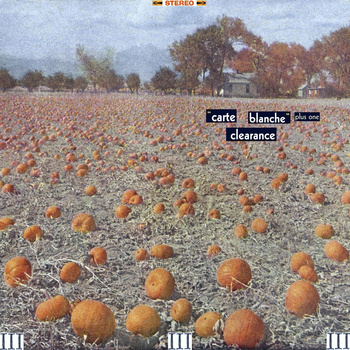
On the 29th March 2014 the band released their 3rd Bandcamp offering “Carte Blanche’ plus one

The sign of a great band lies in their ability to evolve and expand their musical horizons with each new release. Based on the evidence to date Clearance are an embodiment of this notion. There are plenty of bands around who are more than capable of churning out medico material and with the help of a few production twitches and the ad man’s expertise quickly find their faces on anxiety ridden teenage T-shirts. With Clearance you get a real sense of a hard working band seeking to secure appreciation for their art form through a dedication to maintaining independent integrity. This of course is admirable and is worth the ticket price alone, but in reality this means little if the material is not consistent in quality.

Clearance seem to have any ability to toss out brilliant, catchy and intelligent songs. This all bolds well for the future given the solid platform they are building for themselves. The songs are built around clever lyrical structures and offset by guitar textures. Their songs can initially deceive the listener, but lurking beneath a few listens is a revealing depth and intelligence.

Carte Blanche plus one (March 2014)

I’ve listened to Carte Blanche on repeat loop and its one of them songs that never seems to get stale. Looking through the eye of life via a narrative of a road trip the track bounces about gleefully with amazing drum work underscoring the building guitar textures and the eloquent lyrics,  “Darling don’t you dwell upon the exit sign and know that time is going to wound the heals.” The second track is a blend of Misdirection Prize/TV Exhaust is my personal favourite of this release and a supreme piece of work. The fade out and fade into TV Exhaust is at first a little baffling, but ends up providing a rye smile.

I managed to catch up with Mike Bellis from Clearance for a few Old Man questions about the new material:

JK:  What you guys up to at the moment?
MBLaundry, and continuing to waste our money on padding our record collections.
JK: The feel, sound and production on these two tracks demonstrate another step up. How do they feel to you and what feed back have you had?
MB: They feel fine to us – like the last two records they were also recorded in a basement, though this time it was in a different one. We had the luxury of using our friend’s tape machine this time, which always makes things sound better.
JKWhen were the tracks written and what were the main influences at the time?
MB: The tracks were written in January, and when we weren’t listening to friends bands it was probably just the Velvet Underground in ’69 or Danny Kirwan-era Fleetwood Mac. Maybe some Faust too.
JK: Will we get to see a full album release soon?
MB: Yes, eventually.
JK: Any live gigs planned? (UK maybe)?
MB: Only stateside so far, but if we can find anyone willing to pony up the change to send us across the pond we’d be delighted to meet the Queen’s acquaintance.
JK: What are you guys listening to at the moment?
MB: Older stuff mostly- Beefheart, Minutemen, Teenage Fanclub, glam-era Eno, Faust, John Cale (“Fear”), kosmische stuff. But also newer bands like Parquet Courts, Protomartyr, and The Courtneys.
JK: I hear you have a soft spot for Mark E Smith and The Fall?
MB: Who doesn’t?

Back to the Future

Clearance’s back catalogue is also available from Bandcamp – you will do music and the world a favour by purchasing them immediately.

Greensleeve 

Full of amazing hooks and skewed observations this glorious 5 track EP is a little gem. Lo-fi maybe, but high quality throughout. My stand out track: Face the Frontier. 

Dixie Motel Two – Step 

The opening track Walking Papers is simply a classic and would not have gone a miss on an early Sonic Youth album. The EP is again full of hooks and heart warming riffs. In many ways the LoFi production of this early material make it so good.

I demand an LP and I want it now!

Today I Stumbled Upon: The Warm Hardies

The Warm Hardies are Matt Batey and Tamara Power-Drutis on guitar and vocals, Samuel Anderson on cello, Colin Richey on drums, Corrie Strandjord on French horn, as well as Matt Bishop and Eric Anderson on vocals.  With song structures and lyrics that remind me of early Paul Simon the Music for Grown Up EP (released in May 2011) consists of 3 tracks, which gently float between folk and pop. The opening track Fast and Heavy sets the scene for the EP’s lyrical supreme celebration concerning the complications of finding love and relationships. All tracks contain beautiful harmonies and excellent musicianship.  Only Someday changes the pace upwards with Tamara Power-Drutis on lead vocals reminding me of  Neko Case (but different, if that makes sense). The 3rd and final track I don’t love you is the most instantly catchy of the collection ‘Love isn’t convient and its never on time’ and from the laughter heard towards the end its seems to have been fun to record. I asked The Warm Hardies a few questions about the EP via the magic of email:

  • JK: What was the main influences behind the EP? 
  • Tamara Power-Druti: Trains, dinosaurs, and rich harmonies.
  • JK: Which is favourite track and why?
  • Tamara Power-Druti: Fast and Heavy, because we wrote it about trains but it became a song about something entirely different. We liked that, and loved the way the strings came together with the vocal harmonies.
  • JK: If you could have a guest artist to appear on your next venture who would it be (dead or alive) and why?
  • Tamara Power-Druti: The Everly Brothers, and we’d do a mega-harmonied version of Dream.
Not your average couple

Pipe Smokers of the world unite and take over

This collection of songs make for a perfect mix for that feel good moment. I have the 3 tracks on a playlist, which also contains tracks from the likes of REM (Automatic for the People), Neil Young (Harvest Moon) and Crosby, Stills and Nash’s first album where these songs more than hold their own. The EP is available on a name your price basis (don’t be a skinflint!).