Jazz

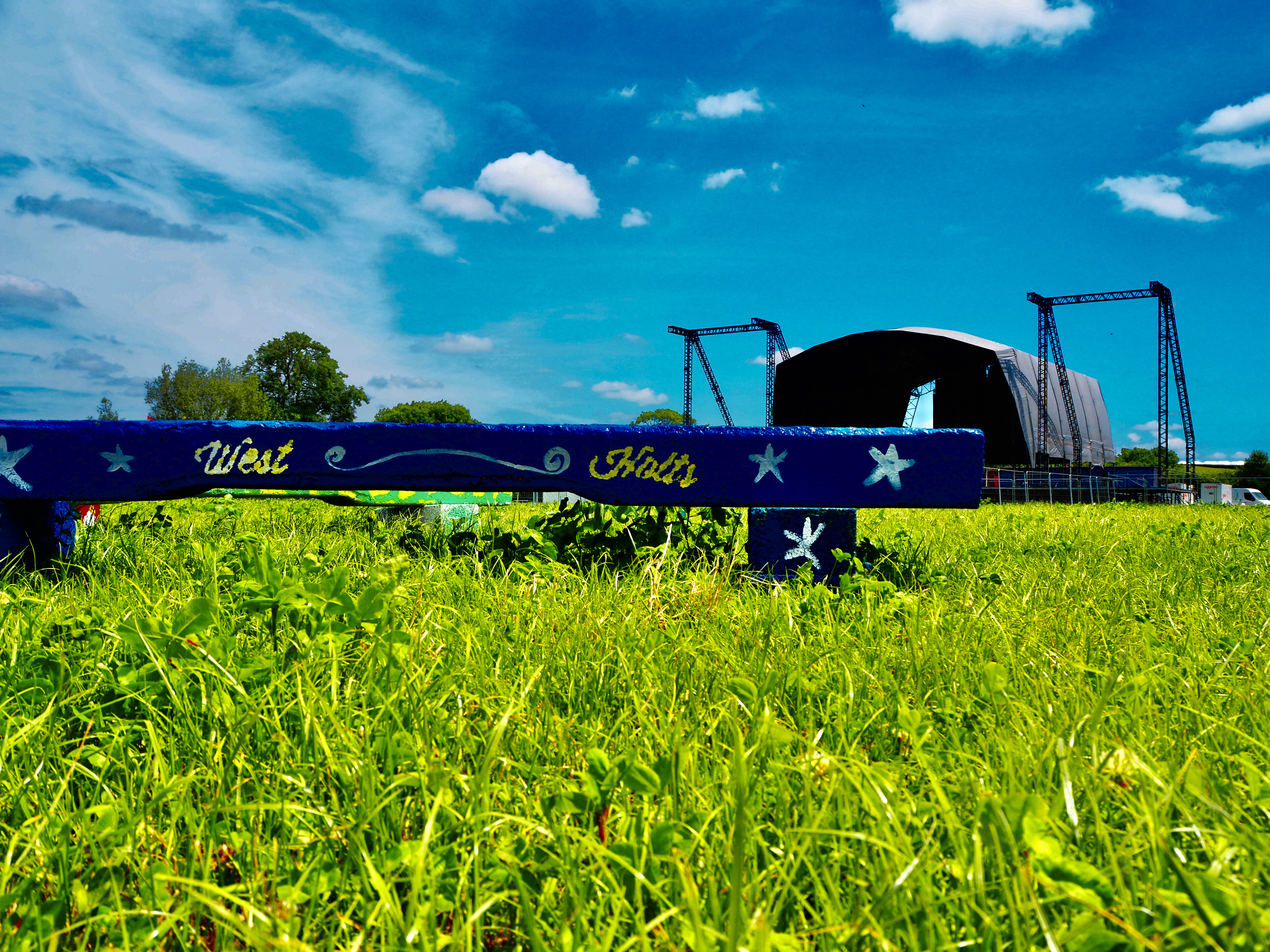
The transition from Jazz World to the West Holts Stage happened in 2010 — a year that, digging through old hard drives, clearly lives up to its memory as a scorchingly hot summer. The photos from that time reveal a festival crowd not just ready to soak up the music but also inventively deploying every creative means to find—or fashion—their own patch of shade. We’ll dive into those sun-smart snapshots soon enough, but for now, let’s start here.

That year marked a turning point behind the scenes, with a series of technical upgrades introduced to support our ever-growing audience. The stage itself saw fresh new dressings that added a fresh visual flair, though the much-anticipated side screens were still absent. The evolution was underway, setting the stage for what West Holts would soon become.

Black Moon

The last time we spoke, beneath a moon swallowed whole by night—a black orb hung heavy in the sky. Cold whispered beneath our feet, pebbles shifting softly as we walked toward the water’s waiting edge. Darkness wrapped us, a cloak sewn from all the miles we’d traveled, each step a silent testament to the journey that brought us here. Around us, breath and tide held sway—the gentle sigh of waves kissing shore, the murmured dance of rigging ropes, swaying in time with restless waters.

And then—

in the stillness between heartbeats,

our thoughts, like fragile boats,

paused on the horizon.

“These moments don’t last forever,

and nor should they,” you whispered—

and with that,

our last words floated out

to mingle with the night.

Camera

I don’t remember much from that day—just fragments, impressions—but it must have been summer 1971. I was about ten years old, and Scarborough was the kind of holiday spot that working-class families from the North-East could afford. The battleships of Peasmole Park, the thrill of getting drenched by the high tide, and my stubborn refusal to ride the infamous cable car—these were the threads of so many joyful childhood memories.

But what I vividly recall is my dad calling me over with that quiet authority he always had. He handed me his small Kodak camera and gave a careful demonstration. “I want you to take a photo of me and your mum, son,” he said. “When I say, don’t just press the button—make sure you can see both of us in the picture.”

I stood ready, heart pounding with importance. My parents arranged themselves—Dad leaning casually against the wall, Mum standing beside him, looking like tin rabbits waiting to be shot in one of those penny arcades we used to visit in the evenings.

“Not yet, son,” came Dad’s voice, patient but firm.

He took Mum’s hand and gently pulled her in front of him. She leaned back slightly as he wrapped his arms around her. “Now,” he said.

I pressed the button.

That simple moment—captured in a frame—holds a world of love, care, and quiet tenderness. It’s a picture of two people who built a life together, who gave me roots and wings. And every time I think of that day, I feel grateful for that brief lesson in how to see, how to hold on, and how to love.


Wheels Turning

Reflections on Conservative Britain Then and Now. There is no greater truth in politics than the inevitability of cycles: what goes around, ultimately comes around. For those disillusioned and dispirited by the current state of British politics, this should serve as a cautious reminder rather than a consolation. Many look back through rose-tinted lenses at the Conservative-Thatcher era of the 1980s—the decade when the unleashed dog of unfettered greed barked loudest and reshaped the nation. But forty years on, striking parallels emerge between that turbulent era and the present day.

I grew up in the North East of England—the so-called heartland of Labour’s “red wall,” a phrase that lazy political commentators brandish with little understanding, whether from London studios or the steps of Downing Street. Yet right-wing, working-class patriotism has long been a complex, often overlooked reality behind those walls, just as it exists behind the so-called “blue wall” of places like Christchurch.

Then as now, the Conservative Party has regularly installed leaders from its elite ranks—born into privilege and crowned by birthright—whose personas are carefully crafted by spin doctors and advisors. In the 1980s, that leader was Margaret Thatcher; today, it is Boris Johnson, a man who revels in the performative trappings of populism—driving garbage trucks, swapping banter with his flat-capped mates in local pubs, and railing against foreigners across the Channel.

But the 1970s and ’80s in the UK were far more than fashion trends, pop music, or flashy consumerism. Beneath the neon lights and padded shoulders, they were a period marked by social fracture and violent unrest. Poverty soared, the gap between rich and poor widened to unprecedented levels, and cities like Brixton, Liverpool, Leeds, Manchester, and Birmingham erupted in protest and revolt.

The death of Blair Peach, killed by the Metropolitan Police’s Special Patrol Group—an infamous unit operating with near impunity—exemplified the brutal state repression of the time. Laws such as the Vagrancy Act 1824 and Clause 28 exploited ignorance and fear, targeting marginalized communities, particularly LGBTQ+ people.

Meanwhile, Thatcher’s government forged cynical alliances with apartheid South Africa, welcoming its leaders as friends while extremist voices within the Conservative Party—some linked by business interests—denounced the African National Congress as terrorists. Calls for the execution of Nelson Mandela echoed at party conferences as violence and unrest shook the country again in 1990 with the poll tax riots. A pattern repeated decades later in 2011 under David Cameron, when riots once again gripped cities across the UK.

Today, the script may be updated, spun, and tailored for the digital age—disseminated through targeted social media ads and disinformation campaigns—but the underlying narrative remains unaltered. The Johnson administration is testing boundaries, deliberately stoking tensions to gauge resistance. The deportations of Jamaicans under his watch echo the playbook of reactionary populists like Trump—dividing communities to consolidate power.

Johnson is a puppet, complicit in a reactionary political project funded by billionaires and oligarchs intent on destabilizing oversight and accountability—most visibly through their war on the EU. Unfettered greed, history tells us, will ultimately self-destruct, but not before poisoning the social fabric in ways that will take years to undo.

Looking back to the 1980s and placing them in today’s context, it is clear that the extent of the coming damage depends largely on the resistance of the younger generations. Until that resistance crystallizes, Johnson will continue to push forward, indifferent to the social consequences. Violence and unrest may not be the inevitable outcome, but given the Conservative Party’s track record, any fallout is too often treated as mere collateral damage.

The wheels keep turning—and so must we, with vigilance and resolve.

Sweetwater: The Underrated Psychedelic Pioneers of the ’60s

Sweetwater is one of those ’60s bands who, through a twist of fate and circumstances beyond their control, never quite received the recognition they richly deserved. What began as a humble house band playing the coffee shops of California quickly transformed into the regular support act for legends like The Doors and The Animals during the late ’60s.

They even charted in the US with their haunting cover of Motherless Child, a song most famously associated with Paul Robeson. Their 1968 self-titled debut album is, in my opinion, a hidden gem of the original psychedelic era—lush, inventive, and all too often overlooked.

Pop culture buffs might know Sweetwater were slated to open the original Woodstock festival in 1969. But due to overwhelming crowds and chaotic traffic jams, they never made it to the stage on time. Later that year, tragedy struck when lead singer Nansi Nevins was seriously injured in a car accident, stalling the band’s momentum just as they were poised for greater success.

My personal favourite from their debut is the mesmerizing My Crystal Spider, while the lyrics of What’s Wrong—check out the video below—feel more relevant now than ever, decades after their release.

If you’re a fan of ’60s psychedelia and haven’t yet explored Sweetwater’s work, this is the perfect moment to dive in. Welcome aboard—let the trip begin.