Category Archives: Blog

Walls

I’ve voted Labour member since I was eligible to vote, and it’s never been about who leads the party — it’s about the values we stand for.

To win government, Labour must see itself as a family of 12 million, building alliances beyond our membership, whether that’s 100,000 or 500,000 strong. In the North, it’s not just political deals but real social networks that matter. It’s not enough to rebuild the Red Wall; we need to understand the foundations beneath it.

Winning means taking Scotland, the North, the Midlands—and beyond. So, when choosing our next leader, Labour friends, think carefully: this decision could keep us out of power for decades or bring us back stronger.

After such a tough defeat, humility is key. We must listen, reflect, learn—and come back more determined. Blame and anger got us here; let’s channel that energy wisely.

Beak>

A Raw Slice of British Grassroots Politics

Tucked away on Sandy Park Road in Brislington, Bristol, The Sandringham Pub stands firm—a no-nonsense local, tired but proud amid the growing café culture around it. Downstairs, regulars exchange stories and catch up on the day’s events, while upstairs, political hopefuls ready themselves for a hustings meeting—an intimate, sometimes chaotic forum where candidates lay out their cases for election or re-election.

Arriving early into a near-empty room, the scene is instantly vivid: an abandoned Father Christmas costume slumps in a corner, a well-worn skittle alley runs along one side, and a Banksy print hangs silently behind. The occasional flushing of toilets, inconveniently placed near the skittle lane, forces the audience to awkwardly navigate behind the speakers—adding a quirky charm to the proceedings.

The organisers’ attempts to arrange the top table provide their own drama. Tables shuffle, six glasses of water repeatedly move back and forth, as they try different seating angles—only to concede that either the chair or a speaker will inevitably end up on the skittle alley itself.

The evening unfolds like a scene from an Armando Iannucci script, mixing pantomime and personalities with genuine grassroots politics. There are serious debates, passionate hecklers, entrenched political tribes, and the occasional bemused visitor who’s clearly taken a wrong turn on the way to bingo.

In an age dominated by spin, social media echo chambers, and soundbites, there’s something refreshingly raw and honest about these meetings. They bring people with clashing views face-to-face, encouraging listening, dialogue, and the stark realisation that shared concerns bind us more than anger divides us. Here, it’s clear: the journey matters as much as the destination.

Brexit, inevitably, looms large. Like a faltering stroke victim struggling to articulate, no other topic escapes its shadow. It’s simultaneously depressing and fascinating to watch, as each speaker’s eyes reveal a shared weariness. We’re all stuck in the same ditch, grasping for symbolic deadlines to “get Brexit done,” yet no one truly knows how to heal the fractures within families, neighborhoods, and communities.

Some politicians push for a knockout victory, but victory over whom? In life, total victory is neither practical nor desirable. The art of compromise may seem absent now—but it’s only a matter of time before she comes knocking. Let’s hope we have the wisdom to answer the door.

Life’s Little Eccentrics

Growing up with a dad from RAF regiment stock meant stories of daring pilots and audacious flights were part of the soundtrack of my childhood. But one tale stood out — the legendary “Hawker Hunter Tower Bridge incident” from April 5, 1968.

Picture this: Flight Lieutenant Alan Pollock, a fearless RAF pilot, was none too pleased that the bigwigs weren’t planning a proper fly-past to celebrate the RAF’s 50th birthday. So, in true rebellious style, Pollock decided to take matters into his own hands — no permission needed.

He soared his sleek Hawker Hunter jet low over the Thames, skimming past the Houses of Parliament, until he reached the iconic Tower Bridge. And then, in a move that sounds more like a stunt from an action movie than a military exercise, Pollock flew underneath the bridge’s walkway! He later confessed that it was a bit of a spur-of-the-moment decision when the bridge suddenly loomed large ahead of him.

The aftermath? Pollock was promptly arrested upon landing and discharged from the RAF on medical grounds — without even a chance to explain himself in court. But for my dad, and many others, Pollock’s daring flight was less about rules and more about spirit — a bold salute to the RAF on its milestone birthday.

It’s the kind of story that reminds me how sometimes, a little rule-breaking can become the stuff of legend.

16.05.19: Benjamin Zephaniah, Trinity Centre Bristol

I had a fantastic evening with Benjamin — a truly memorable night of great music and vibes. But there’s a serious problem that keeps popping up at gigs lately: people chatting through the performance. I noticed it most recently at the Massive Attack shows. It’s baffling how some folks just don’t seem to respect the artist or the audience around them. If you’re not going to give your full attention, why not just stay home and listen to a CD?

That aside, Mr. Zephaniah was in top form, and the band played tight, making for a genuinely enjoyable night. It also reaffirmed something I’ve long suspected — white people really can’t dance, and let’s be honest, we rarely pull off the dreadlocks look with any real cool factor!

Summer Holidaze

Stanley stood rigid at the curb, Doris by his side, her hand brushing his. Down the hill, the driverless bus thundered toward them, metal beast on wheels, scraping inches past where they waited. Inside, a tempest roiled.

Passengers brawled, voices cracking like broken glass. Village faces peered anxiously, jaws tight, eyes wide.

Theresa sat just behind the empty driver’s seat, fingers stuffed in her ears, lost to the storm. Opposite her, Jeremy covered his eyes, peeking through his fingers at the vacant wheel, whispering a prayer—hope and defiance tangled on his breath.

Behind them, Nigel’s long finger jabbed accusingly at the last few who’d boarded. “Sabotage!” he barked, voice sharp enough to cut glass.

A small mob spat curses—at one another and at the chaos itself. The bus jolted over bumps, and Ariaf’s grip slipped. A vanilla shake splattered over Tommy’s new school uniform. He wailed, clutching Bernard, his pet snail, now hidden away in a cardboard box. “How’m I gonna tell Mum?” he sobbed, finger already pointing.

Vince bounced up and down, desperate for notice after being banished for helping David—the driver—to escape through the emergency hatch.

Nearby, self-styled ideologues debated, trading grudging praise for the 1939 Molotov–Ribbentrop Pact, their eyes glittering with twisted admiration.

Caroline sat alone, calm and patient, knitting a jumper stitch by stitch, waiting.

As the looming brick wall hurtled closer, Chuka, Anna, and Heidi linked hands with others, raising their voices in ancient hymns.

Nicola shouted for a show of hands—any brave souls willing to climb to the roof. Ariene screamed, “No surrender!” as the wall grew impossibly close.

Meanwhile, the nation sat glued to radios, Cliff Richard’s Summer Holiday on eternal repeat, young faces exchanging helpless, desperate looks.

Stanley caught Doris’s eye, his voice soft but certain. “Ah Doris, Brexit means Brexit.”

She licked her melting ice cream, then turned to the pelican crossing button. The sharp beeping sliced the chaos, halting cars. Hand in hand, they stepped off the curb, away from the madness, crossing to the bus station as if nothing had changed.

Life’s Little Embers

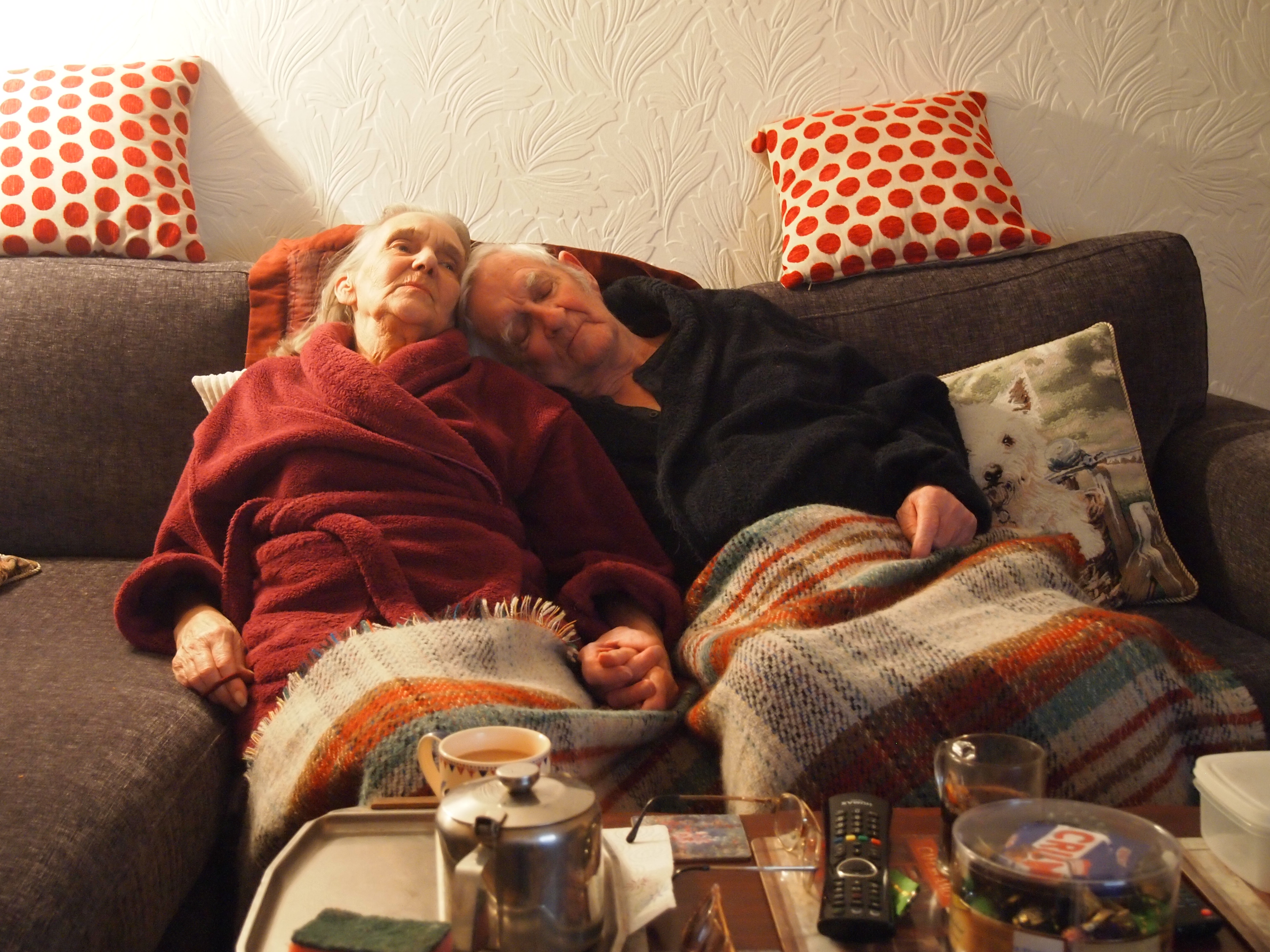
I once heard a quote, “a person does not truly die until the last person who knew them, to speak their name, also dies.”  I find much beauty and poignancy in such an observation. It is one that gives context and comfort during those periods when context and comfort are not in abundance. It is within this context that I write a small piece on 3rd May, each year, for my parents. During the final years of their lives, I took regular photographs of my parents so I could share them with their grandchildren, great-grandchild and wider family. Stored securely on a memory stick on this day I take that memory stick out, select a photograph and write a little something. Initially on closed social media platforms like FaceBook and more lately on open media like this from last year. This photograph was taken a couple of weeks before Mum’s health deteriorated rapidly over a very short period of time.

They had a routine, which generally consisted of them living separate lives during the day with occasional chats as one of them would make a pot of tea or meal. Dad, in the front room with his latest model building project. Mum, in the back room, reading and watching the latest soap. Pet dog seeking attention from either one of them. Each evening they would share their meal, cuddle up, natter and watch TV.

In my final year with them, I got the opportunity to hug them, share stories, tell them how much I loved them, explain to them how proud I am to be their son. As a family, to express in their later years that it was an honour to care for them. This became the foundation for coming to terms with not having them physically in our lives. It’s the small stories that become important. My dad asking for, “gingersnap biscuits to be put in his pocket when we put him in his box.” My mum reminding us, “make sure your dad gets his meals” during last days she was able to communicate. The search for my mum false teeth after she passed away and then to find her gnashers many months afterwards in the back of my car without any rational reason why they should have been there. I’m also happy to report that nothing gives me more satisfaction than hearing their grandchildren and great-grandchildren share these small anecdotes.

End Games

Realisation has a way of sneaking up on you—slow, almost imperceptible, yet wrapped tightly in the simplest form of common sense. For me, it came quietly toward the end of 2018, the moment I deliberately stepped back from social media groups, especially those sprawling Facebook communities. What began as hopeful spaces for open dialogue and genuine free speech among people with differing opinions had morphed into something far darker.

This past weekend, curiosity got the better of me, and I tentatively dipped my toes back into that digital ocean.

The calm I’d grown accustomed to over months evaporated instantly—like morning mist chased away by the harsh glare of the sun. Within hours, I was pulled into a whirlpool of toxic arguments, rife with intolerant attitudes and bitter resentments. One particular Facebook group felt less like a forum and more like a grim echo chamber—populated mostly by frustrated, angry voices, overwhelmingly white men, lobbing lazy, manufactured memes and personal attacks with the fury of children flinging custard pies. That’s where we’ve landed. Is this really the state of discourse in the UK?

We don’t talk anymore. Worse, we don’t listen. Instead, we shout louder, mock more viciously, and often seem determined to wound each other. Our nation feels splintered, like a fragile union trembling on the brink of collapse. Battles over identity rage at the extremes, while the silent majority looks away, burdened by shame and embarrassment. Meanwhile, the rest of the world watches in disbelief, trying to make sense of a once-proud country unraveling before their eyes.

And so, on that Saturday, I did something quietly radical. I switched off from the noise and digital chaos, stepped outside, and said hello to a complete stranger while walking my dog. Sometimes, that’s where true connection begins.

When the Person You Knew Becomes a Stranger

I want to share a recent experience that shines a small but revealing light on a troubling trend sweeping communities—not just here in the UK, but in the US and beyond. It’s about perception, personal accountability, and the double lives some people choose to live. It’s about how we engage and communicate as we shift between our real, everyday lives and the virtual world of social media, where the person you think you know can suddenly feel like a complete stranger.

Most importantly, it’s about how ignorance is preyed upon to deliberately fuel hate and toxicity—poison that has seeped deep into our culture and been weaponized by politicians. George Orwell’s classic 1984 introduced us to “doublespeak,” where words mean their opposite: when Big Brother says “Love,” he means hate; when he says “Peace,” he means war.

When my family and I left Salisbury after seven happy years and returned to Bristol, we left behind a circle of friends who enriched our lives and whom we still cherish. Our Salisbury neighbours, the vast majority, treated us with kindness and warmth. Among them was Peter—a handyman, a regular visitor, someone we trusted. Even our dog, Poppy, lit up at his voice. Peter was there when we needed him, or so we thought.

But once we settled in Bristol and reconnected with friends on Facebook, a harsh and unsettling truth emerged. Suddenly, hateful posts and images from extreme right-wing groups started appearing in my feed—posts far beyond shock-jock tastelessness and often linked to groups known for violence.

The source? Peter.

He posted ugly, offensive content. His obsession with reinstating the Golliwog doll as a symbol of “Britishness” was particularly disturbing. After my wife sent him a heartfelt message calling out his behaviour, he responded with nothing but a thumbs-up emoji—and carried on.

I decided to confront his hate head-on, not expecting to change his mind, but hoping to plant a seed of doubt in his followers and family who witnessed the online clash. It didn’t surprise me that hateful voices quickly retreat when challenged calmly, only to sneak back once they think no one is watching. That’s exactly what Peter did.

Recently, noticing his posts getting fewer likes, Peter launched attacks on my Facebook page. He’s a staunch supporter of Brexit, UKIP, and Trump-style politics—his bigotry clearly intertwined with his politics. Watching him stumble and flail as my friends challenged him online became one of my moments of the year.

Things escalated further after he tried to use Remembrance Sunday to score cheap political points. I simply asked him to show some respect for those who made the ultimate sacrifice. Not long after, he returned to his Golliwog fixation. When I challenged him again, he defended himself with the tired excuse of having non-white friends, then blocked me after I asked if he’d buy his friends’ children such a doll for Christmas.

Peter is a textbook case of Orwellian doublespeak. What he says and what he does are worlds apart. The toxic content he shares is fed to him by extremist groups he chooses to associate with—and in doing so, he becomes a reflection of them.

Why share this? First, I’m relieved Peter is no longer part of our lives. But more importantly, we live in dangerous times when decency and moderation seem out of fashion, and reactionary, nationalist, racist politics try to claim space. These voices are not the mainstream, and they never will be.

Those of us who know better must stand united, calmly resist, and push back the hate under the rocks it crawled out from. Have the courage to challenge those who mean harm, no matter who they are. And remember the wise words of Bill Hicks: “Love all the people all the time.”